Many London homeowners already have perfectly good manual driveway gates but have grown tired of getting out of the car every time they come home. If your gates are structurally sound and properly hung, adding electric automation is usually a straightforward project and far cheaper than replacing the entire gate.
Retrofitting automation is also a quicker route to results. A new bespoke gate can take six to ten weeks from order to installation. An automation retrofit on existing gates can usually be completed within two to three weeks of booking, sometimes faster.
Is Your Gate Suitable for Automation?

Not every manual gate can be automated effectively. Before an installer commits to a retrofit, they will check the weight of the gate, the condition of the hinges, the strength and stability of the posts or pillars, and the overall structural integrity of the gate itself.
As a general guide, most swing gates under 300kg per leaf and most sliding gates under 600kg can be automated using standard residential motors. Very heavy wrought iron gates may require commercial-grade motors, but the retrofit is still entirely viable in most cases.
Hinge condition matters significantly. Worn or corroded hinges cause alignment problems that get worse under motorised operation. If the hinges need replacing, this is usually done as part of the automation project.
Free Matching Service
Ready to get driveway gate quotes?
Get matched with vetted London installers — no obligation, no cost.
Motor Types for Swing Gate Retrofits
For swing gates, there are two main motor configurations. Ram-arm motors mount on the face of the post and connect to the back of the gate via an articulated arm. They are the most common choice for retrofits because installation is straightforward and they are compatible with most existing post configurations.
Underground motors are hidden within a chamber excavated beneath the post cap. They produce a very clean aesthetic because there is nothing mechanical visible above ground. The trade-off is cost and installation complexity: fitting underground motors to existing posts requires excavation and careful structural work.
Motor Types for Sliding Gate Retrofits
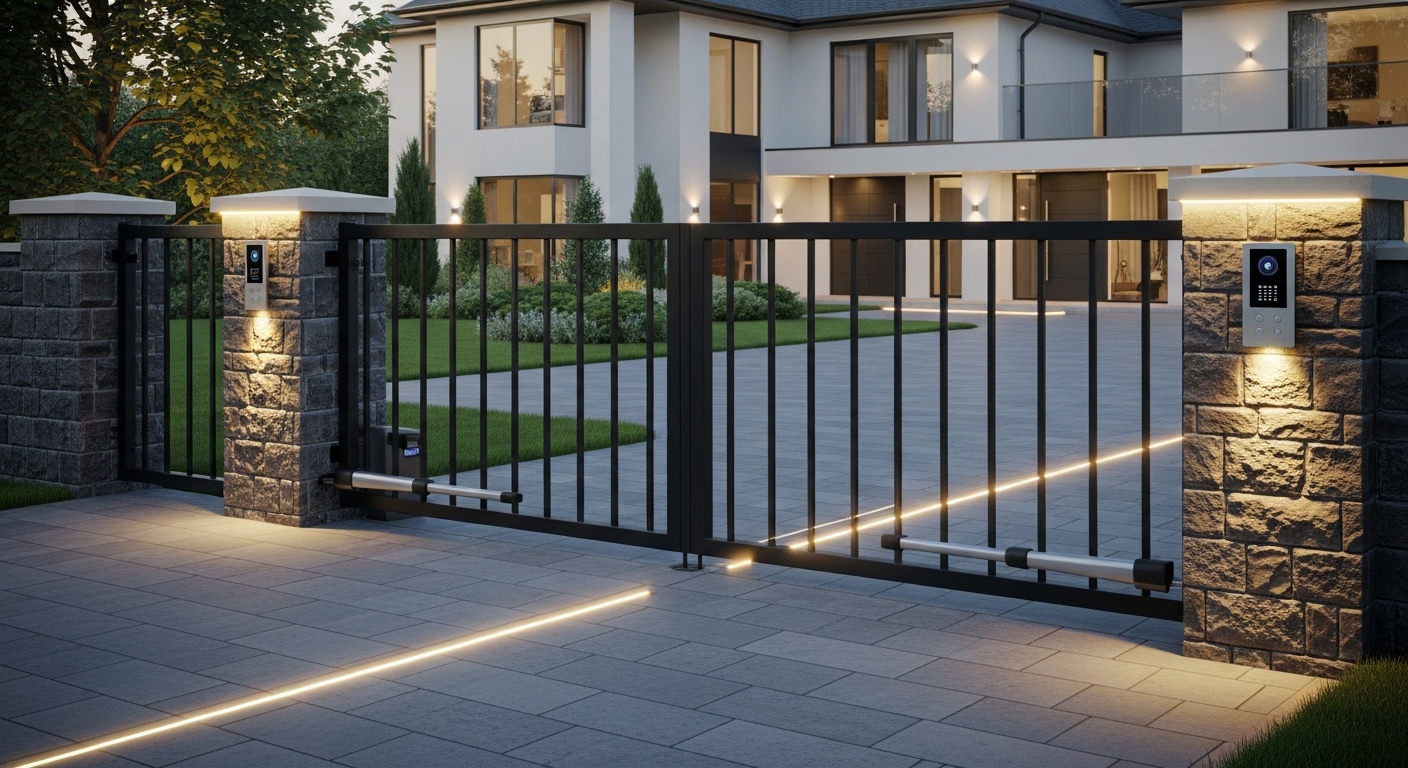
Sliding gate automation uses a rack-and-pinion drive. A toothed rack is fixed along the base of the gate panel, and the motor unit drives the gate along the track via a rotating pinion gear. The motor unit is housed in a steel cabinet bolted to the ground beside the gate.
If your existing sliding gate does not have a ground track, a new track will need to be laid and the gate adapted to run on it. Alternatively, if a track-free solution is needed, a cantilever conversion is possible on some gates.
What a Standard Automation Package Includes
- Motor unit or units: one per leaf for swing gates, one for most sliding gates
- Control board with adjustable settings for speed, force limits, and travel length
- Two remote handsets as standard, with additional remotes available at a modest extra cost
- Safety photocells: infrared sensors that detect objects in the gate path and trigger auto-reverse
- Manual release key: allows the gate to be operated by hand during a power cut
- Flashing amber warning light that activates whenever the gate is in motion
- Programming and testing to confirm all safety devices are operating correctly
Optional Extras Worth Considering
The standard package gives you a functional automated gate, but most homeowners find they want at least some additional features once they understand what is available.
- Video intercom: see and speak to visitors on a colour screen inside the house, with night vision for evening use
- Smartphone-connected intercom: answer the gate from your phone anywhere in the world and release the gate remotely
- Keypad: allow family members or regular tradespeople to enter a PIN code without needing a remote
- Wi-Fi gate control module: open and close the gate from a phone app and see a log of gate operation times
- Battery backup unit: keeps the gate cycling for 20 to 50 open-close operations during a power cut
- Safety edges: pressure-sensitive strips on the gate leading edge that trigger immediate stop and reverse on contact
What Does a Retrofit Cost in London?
A basic automation retrofit for a pair of swing gates, including two ram-arm motors, safety photocells, a warning light, two remote handsets, and full installation, typically costs between £1,200 and £2,500 in London. Adding a wired colour video intercom brings the total to around £2,000 to £3,500. A comprehensive package with intercom, keypad, Wi-Fi control module, and battery backup generally falls in the £3,000 to £4,500 range.
Sliding gate retrofits cost somewhat more because the motor unit is larger and a toothed rack needs to be fixed to the gate. Expect £1,800 to £3,500 for a standard sliding gate retrofit with a basic package.
How Long Does Installation Take?
Most swing gate automation retrofits using ram-arm motors are completed in a single working day. The installer arrives, fits the motors, runs and connects the cabling, installs the control board, fits and aligns the safety photocells, and tests and programmes the complete system before leaving.
Underground motor retrofits take longer because of the excavation and structural work involved, typically one and a half to two days. Disruption to your property is minimal in almost every case.
If you already have manual gates that you are happy with, automating them is one of the most practical home improvements you can make in terms of cost versus daily quality-of-life improvement. Book a free site survey and get an honest assessment of what your existing gates will support.