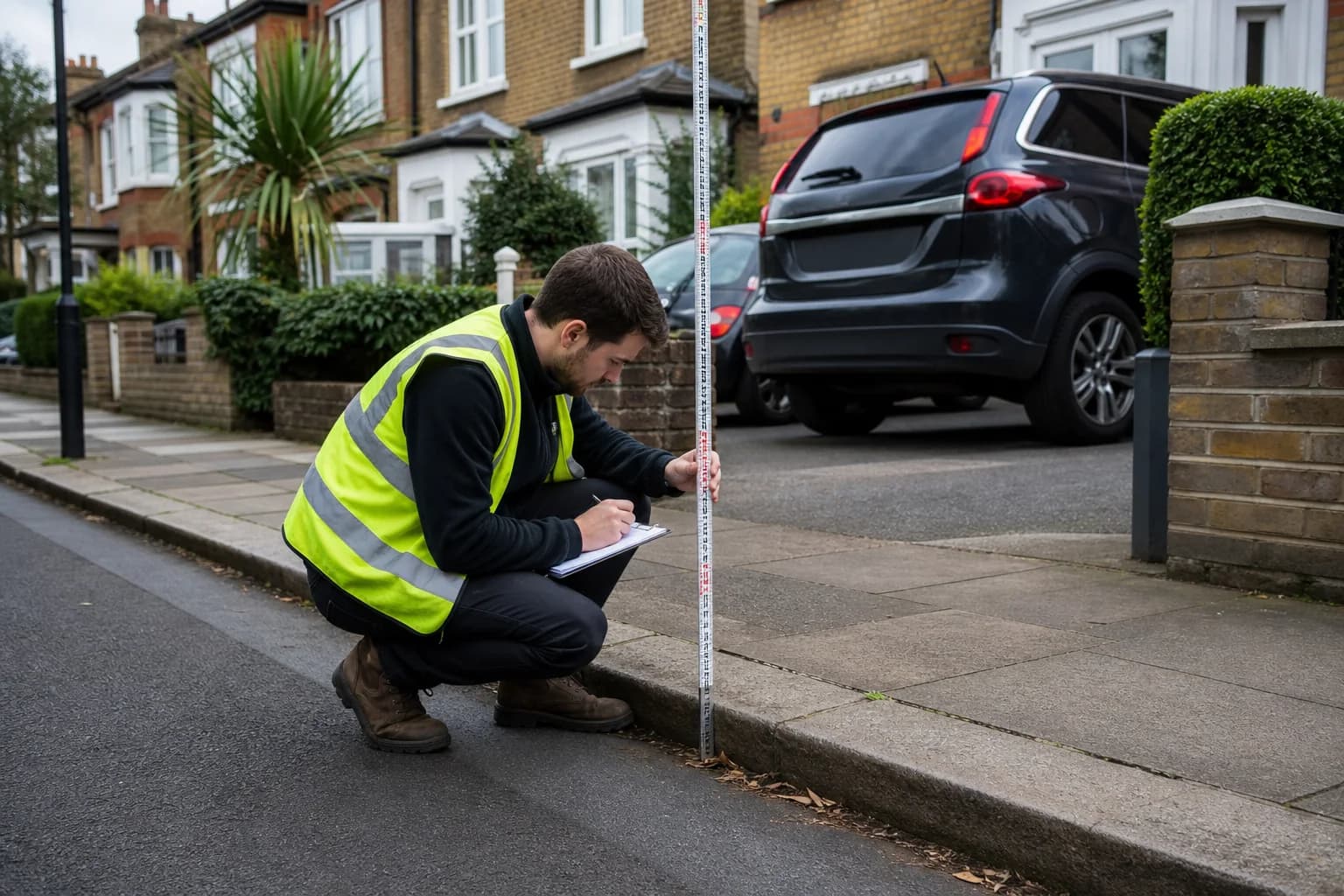
It is one of the first questions Londoners ask when they start planning an entrance, and the honest answer surprises a lot of people. Fitting a driveway gate and getting a dropped kerb are two separate jobs, run by two different parties, and one does not automatically come with the other. You can have a perfectly legal, fully working gate installed without ever touching the kerb. You can also have a dropped kerb without a gate. Whether you need both depends entirely on how your vehicle reaches the driveway in the first place.
This article clears up the confusion so you know what applies to your property before you ask for a quote.
The short answer
You need a dropped kerb if a vehicle has to cross the public pavement, the footway, to get from the road onto your driveway. That requirement comes from the highway, not from the gate. A dropped kerb, also called a vehicle crossover, lowers and strengthens the section of pavement your car drives over so the surface and the pipes and cables underneath it are not damaged. Under the Highways Act you must have an authorised crossover in place before driving a vehicle across a footway, and you apply for one through your local council rather than arranging it privately. The Planning Portal and GOV.UK both point you to your council to apply for a dropped kerb, because the footway is council-owned highway and only the council can authorise work on it.
The gate is a different matter. Your gate sits on your own boundary, on your land, behind the building line. Installing it does not, by itself, require a dropped kerb. So the two questions to separate in your head are these: does my car already cross a lowered, authorised kerb to reach the drive, and do I want a gate at the entrance. If your driveway already has a proper crossover, you can go straight to a gate. If it does not, the crossover is a council job you arrange in parallel, and it is not part of the gate installation.
Ready to get a driveway gate quote?
We install across London. Free site survey and written quote, no obligation.
Why the dropped kerb is a council job, not a gate job
This is the part worth being clear about. We fit and automate gates. We do not lay vehicle crossovers, and no reputable gate company in London will promise to. The crossover is highways work on public land, and the council controls who carries it out. In most London boroughs the council uses its own approved contractor for the construction itself. The London Borough of Harrow, for example, states plainly that its own contractors are the only ones approved to do this. Other boroughs run the same model, using a term highway maintenance contractor for every crossover.
What that means in practice is simple. If your property needs a crossover, you submit an application to the council, they inspect the location, they confirm whether it is feasible, and their contractor builds it. A gate installer cannot shortcut that process and should never claim to. Anyone who tells you they will sort the dropped kerb as part of fitting your gate is either misunderstanding the rules or hoping you do not know them. Treat the crossover as its own line item, handled by the council, separate from the gate quote.
When you already have a crossover
A large share of London driveways already sit behind an authorised dropped kerb, often put in years ago by a previous owner. If yours is one of them, you are in the straightforward case. The pavement is already lowered and strengthened, your car already crosses it legally, and there is nothing further to arrange with the council before adding a gate. The only thing to check is that the gate design suits the space you have, which is a question of swing, slide or fold rather than kerbs.
This is where the entrance type starts to matter. On a short or shallow frontage, a gate that swings outward over the footway is not acceptable, and a gate that swings inward eats into the driveway depth you need for parking. Many London homes solve this with a sliding or telescopic arrangement, or with automated gate systems that open inward on sensors so a car never has to wait in the road. The point is that an existing crossover removes the council from the equation and lets you focus purely on the gate.
When you do not yet have a crossover
If your car currently bumps up over a full-height kerb, or you park on the road and want to start using the front garden as a driveway, you are in the second case. Here the dropped kerb comes first, because without an authorised crossover you are not permitted to drive across the footway at all, and the gate is pointless until the access is legal.
A few London-specific triggers are worth knowing before you apply. If your frontage sits on a classified road, an A or B road or a busy distributor route, the council applies stricter highway-safety criteria and some applications are refused on visibility or traffic grounds. Boroughs also set a minimum usable driveway depth, commonly around five metres, so a vehicle can sit clear of the pavement once parked. Conservation areas and streets under an Article 4 direction add a further layer, because the council may want to protect the look of the street and can restrict or refuse new crossovers. None of this stops you having a gate later, but it shapes whether and where a crossover is possible, which is why it comes first. Our borough-by-borough notes on London's local planning and highway rules are a useful starting point before you contact the council.
Does the gate itself need permission?
Worth a quick word, because people conflate this with the kerb. The gate and the crossover are governed by different rules. A gate next to a highway is generally permitted development if it is no taller than one metre, with greater height allowed away from the highway boundary, though conservation areas and Article 4 directions can change that. The dropped kerb is a separate highways consent handled by the council. You can need one without the other, both, or neither, depending on your property. The cleanest way to find out is to look at your own frontage rather than your neighbour's, since two houses on the same street can sit under different rules.
How to find out what applies to you
The quickest route is to work backwards from how your car will reach the drive.
- →If a lowered, authorised kerb is already there, you can go straight to choosing and fitting a gate.
- →If your car has to mount a full kerb to reach the drive, you need a council crossover first, and that is a separate council-run job with its own application and the council's own contractor.
- →If your frontage is on a classified road, shallower than the council's minimum depth, or inside a conservation or Article 4 area, check the crossover feasibility with the council before you commit to anything else.
When you are ready for the gate, that is where we can help. We handle the gate itself, the design, the build and the automation, around whatever access arrangement you have. Use the quote form on this page to tell us about your entrance, we will call you back within 24 hours, and we will advise on the right gate for your frontage at a free site survey before giving you a written fixed quote. We do not carry out the dropped kerb or any council crossover work, but we will make sure the gate side is handled properly once your access is sorted.
Tell us about your driveway using the form above and we will call you back within 24 hours to arrange a free site survey and a written fixed quote.