
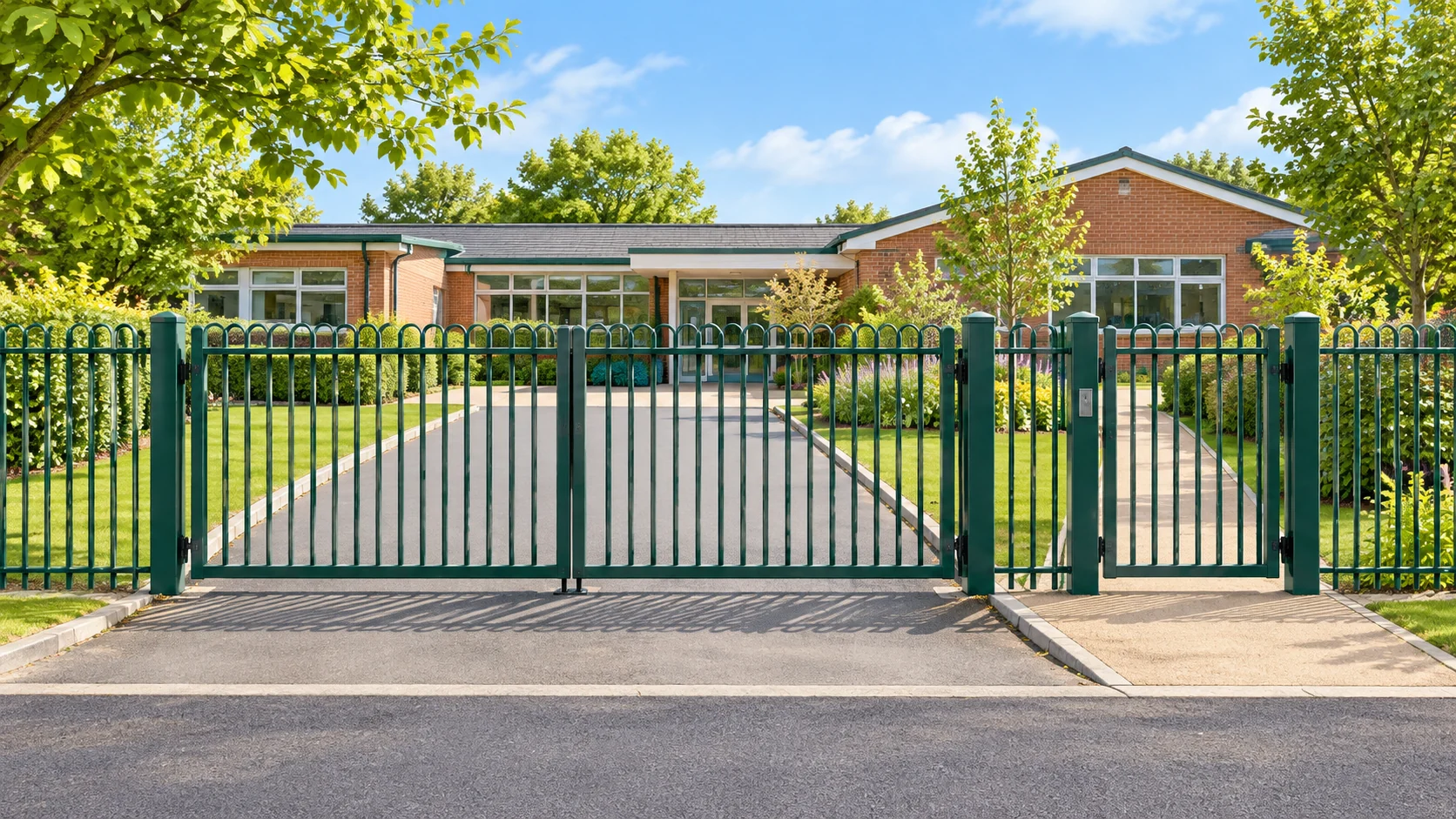
How a well-planned school entrance works
Most schools work best with vehicle and pedestrian routes kept separate. The vehicle gate stays shut during arrival and collection, when the pavement is busiest with children. Staff parking and deliveries are timed around those windows, or routed through a second entrance if the site has one.
Pedestrian gates are usually left open for the morning arrival period and then locked. From then on, visitors enter only through a controlled point: a gate with a video intercom to the school office, released remotely once the visitor has been identified. On larger sites, an airlock (a small fenced holding area between the outer gate and the building) stops a visitor reaching the playground or entrance until reception has let them through the second gate. Staff use a fob, card or code. Fobs and cards are easiest to manage, because a lost or leaver’s fob is cancelled without changing anyone else’s access.
Fire safety has to be planned in from the start. Any electrically locked gate on an escape route needs to release when the fire alarm sounds, or have a clearly marked manual release. That decision is made with the school’s fire risk assessment, not after the gate is installed. Vehicle gates also need a way for the fire brigade to get in out of hours, usually a key switch or a link to the alarm system.
Choosing the right gates
For vehicle entrances where children walk nearby, sliding gates are usually the better choice. They don’t swing out across the pavement or playground, and they handle wide openings well. Any powered gate on a school site needs photocells and safety edges, and closing forces must be tested against BS EN 12453. Mesh or bar infill needs guarding where it slides past posts, so small fingers can’t be trapped. The gate’s speed and the automatic closing delay are set with the school’s daily routine in mind, not left at the factory defaults.
Pedestrian gates are generally manual, with hydraulic self-closers and an electric lock. They should have anti-finger-trap hinges and a lock that holds firmly against a determined push. Under the Equality Act, the gate opening, the push buttons and the intercom need to work for wheelchair users and parents with buggies. That affects the gate width and the height at which controls are mounted.
The fencing and gates should match in height and design. School perimeters are typically 2.0 to 2.4 metres high, in weldmesh or vertical-bar railings with no climbable horizontal rails on the outside. Powder-coated finishes in the school’s colours are standard.
Linking to your existing systems
Many schools already have a visitor management system, CCTV or a door entry system on the main building. Gate intercoms and access control can often be linked to those, or managed from the same software, so the office has one screen for the gate and the front door. Whether that’s possible depends on the specific products. We check the exact model numbers at survey stage, rather than promising a link we haven’t confirmed.
Installation around the school year
Groundworks, ducting and gate installation are planned for half-terms and the summer holiday, so the site is never left without a secure perimeter while pupils are in. Larger projects are often phased over two holidays. Summer is the busiest time of year for school contractors, so getting in touch in spring gives you the most choice of dates.
Procurement and paperwork
We provide what schools, academy trusts and local authorities normally need: a site-specific risk assessment and method statement, insurance certificates, DBS checks for staff working on site, and drawings for approval. At handover you get operating instructions, staff training on daily use and emergency release, and the records your premises team needs. If you’re buying through a framework or need several quotes for your procurement rules, tell us at enquiry stage.
Cost of school gates and entrance security in London
As a rough guide, a powered sliding vehicle gate for a school entrance typically costs £8,000 to £20,000 installed, depending on width, groundworks and access control. A controlled pedestrian gate with an electric lock, self-closer and video intercom is usually £3,000 to £7,000. Airlock entrances, new perimeter fencing and links to existing systems are priced after survey. Every quote is itemised and fixed in writing.
Maintenance
Powered gates on a school site should be serviced at least every six months. That means a full safety check, force testing, adjustment and a written record each visit. HSE guidance on powered gates makes clear that whoever controls the site is responsible for keeping them safe. Between services, the premises team should check daily that the safety devices work and that nothing is damaged. We show them what to look for at handover. For existing gates that are faulty or out of service, see gate repair and servicing.