
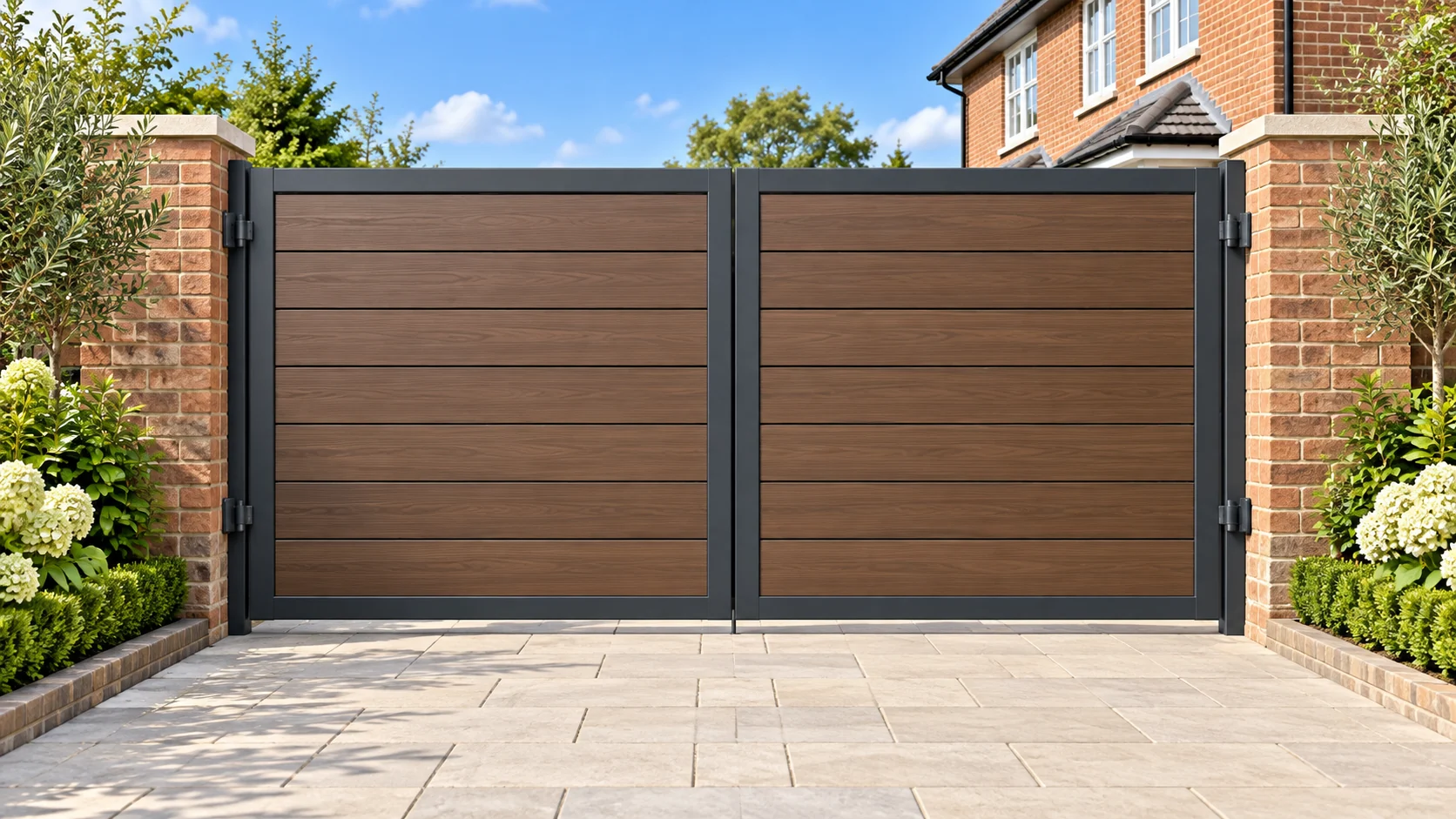
What composite actually is
Most composite gate boards are wood-plastic composite: a blend of wood fibre and recycled plastic, extruded into boards with a wood-grain texture. They’re stable, rot-proof and need no paint. Not all composite boards are equal, and the biggest difference is whether the board is capped.
Capped (co-extruded) boards have a tough polymer shell bonded around the core. That shell resists fading, staining, scratches and mould far better, and keeps the colour close to the sample you chose. This is what we recommend for gates.
Uncapped boards are cheaper first-generation products. They lighten noticeably in their first months outdoors, absorb more moisture and are more prone to marks and mould. They’re common in budget fence panels, and are the main reason some people think composite looks tired after a few years.
Colours range from greys and charcoals to warm browns and teaks. Dark boards look striking, but they get hot in direct summer sun and show dust more, which is worth bearing in mind on a south-facing frontage.
Frames and construction
Composite boards aren’t strong enough to form a gate on their own, so they’re fitted into a powder-coated aluminium frame. The boards slot into channels in the frame, so there are no visible screws on the face, and a damaged board can be slid out and replaced rather than the whole gate being rebuilt. Aluminium won’t rust, keeps the gate’s weight down, and comes in colours to match or contrast with the boards. Anthracite and black frames are the most popular.
Composite expands and contracts with temperature more than timber does, mostly along the length of each board. A properly designed gate leaves room for that movement in the frame channels. Boards screwed tight into a homemade frame can bow or buckle in a hot summer.
Privacy, design and wind
Most composite gates are horizontal boarded. Boards set tight together give full privacy, while small gaps between them let light and air through and give you a glimpse of the road as you pull out. Gates can be flat-topped, which is the most common and suits modern houses, or finished with an aluminium slatted top section. A matching pedestrian gate and composite fence panels keep the whole frontage consistent.
A solid boarded gate catches the wind like a sail. That doesn’t rule it out, but on exposed or wide entrances the frame, hinges, posts and any motors need to be sized for wind load as well as weight. Leaving small gaps between boards noticeably reduces the load.
Composite, timber or aluminium?
Compared with timber, composite needs no staining or painting, won’t rot or split, and keeps a consistent colour. Real wood looks and feels more natural up close, can be planed and refinished, and is often preferred in conservation areas. See wooden driveway gates.
Compared with aluminium, composite has a softer, more wood-like texture and a warmer look. All-aluminium slatted gates (including wood-effect finishes) are lighter, slimmer and offer more design options, especially for very wide or sliding gates. See aluminium driveway gates.
Automation
Composite gates on aluminium frames automate well. Swing gates take ram, articulated arm or underground motors, chosen to suit the gate’s width, weight and wind exposure, the depth of your piers and how the gates need to open. Where the drive slopes up behind the gate, or there isn’t room for leaves to swing, a composite sliding gate is often the better answer. See electric swing gates, electric sliding gates and our swing vs sliding guide. If you already have a gate you’d like to motorise, see gate automation retrofits.
Looking after a composite gate
Composite is low-maintenance, not no-maintenance. Wash the boards with warm soapy water and a soft brush once or twice a year, more often near busy roads where traffic grime builds up. A pressure washer is fine on a low setting held well back from the surface. Capped boards can’t be sanded, so deep scratches are dealt with by replacing the board. Grease the hinges and check the fixings once a year, and have any motors and safety devices serviced to the installer’s schedule. Composite manufacturers typically offer long warranties on capped boards, often 10 years or more, so keep the paperwork.
Planning permission
Under permitted development rules, gates next to a road or footpath can usually be up to 1 metre high without planning permission. Taller gates need consent, and conservation areas and listed buildings have stricter rules. Composite can be a harder sell in some conservation areas than timber or traditional metal. Our borough planning guides cover the local position.
Cost of composite driveway gates in London
As a rough guide, a pair of aluminium-framed composite driveway gates typically costs £2,500 to £5,000 supplied and fitted, depending on width, height and board specification. Automation usually adds £2,500 to £6,000. Sliding gates, new posts, pier work, groundworks and matching fence panels are quoted separately. Our gate cost guide has a checklist for comparing quotes.