
Choosing the right gate type
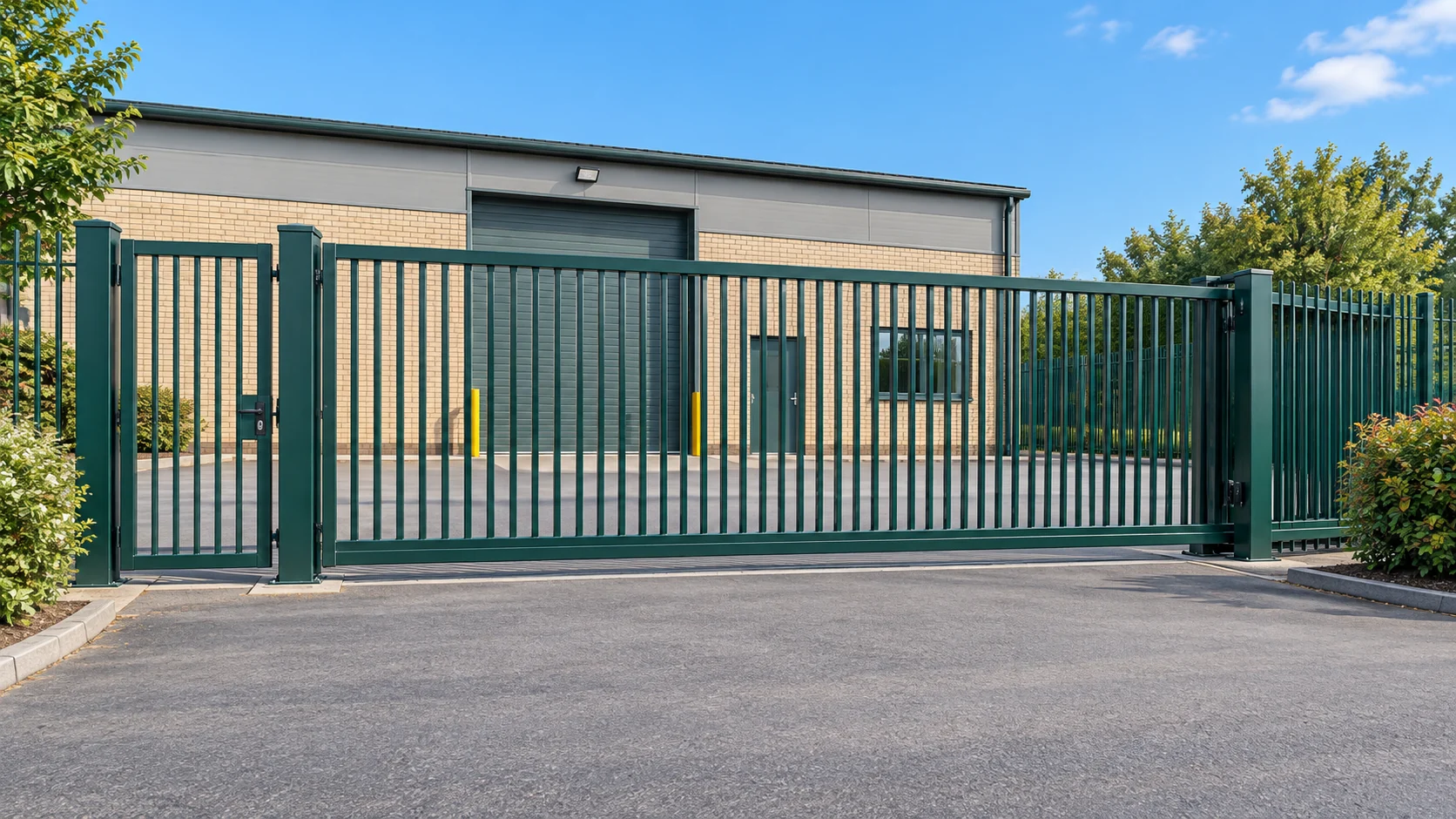
Cantilever sliding gates are the standard choice for industrial entrances. The gate hangs from rollers on posts beside the opening instead of running on a ground track, so grit, ice, pallets and debris can’t jam it. A single leaf can span a very wide opening, comfortably wide enough for an articulated lorry. The trade-off is space. The gate needs a straight run alongside the fence, longer than the opening itself, because part of the frame acts as a counterweight. Our heavy-duty sliding gates page covers these in more detail.
Tracked sliding gates run on a rail set in the ground. They need less run-back than a cantilever gate, but the track has to be kept clear. That makes them a weaker choice for yards with loose material or heavy plant crossing the threshold.
Speed gates are bi-folding gates driven by powerful motors. They open in a few seconds rather than the 20 to 30 seconds a typical sliding gate takes. They suit busy entrances where vehicles would otherwise queue onto the road, and sites where tailgating through a slow-closing gate is a security problem. They fold back within their own posts, so they need very little side space. They cost more than a sliding gate.
Swing gates are the cheapest powered option and work where there’s room for the leaves to open fully without clashing with waiting or turning vehicles. Wide leaves with solid infill catch the wind badly, so on exposed sites they need heavier hinges and operators, or a different gate type.
Barriers control vehicles but don’t secure a perimeter. Many sites use a barrier for the busy working day and a gate to lock the site at night. See car park barriers.
Security ratings
If your insurer, landlord or tender asks for a rated gate, you’ll normally see one of two standards. LPS 1175 (from the Loss Prevention Certification Board) rates how long a gate or fence resists a deliberate forced attack, and with what tools. Lower ratings cover hand tools; higher ones cover extended attack with powered cutting equipment. Hostile vehicle mitigation ratings (PAS 68, IWA 14 and ISO 22343) are crash-tested ratings for stopping a vehicle being driven through the entrance. They’re usually only needed for critical infrastructure and high-risk sites.
A rating applies to the exact tested product, including its posts, foundations and locking. A heavy-looking palisade gate isn’t rated just because it looks strong. If you need a rating, we’ll supply the certification for the specific gate and configuration in the quote.
Most sites don’t need a formal rating. For them, the practical choices are what count: anti-climb mesh (358 mesh is the common high-security standard) or triple-pointed steel palisade, a height of 2.4 to 3 metres, no horizontal rails on the outside to climb, and shrouded hinges and locks that can’t easily be cut.
Planning for lorries and busy periods
Tell us the largest vehicle that uses the entrance and how it arrives. A 16.5-metre articulated lorry needs room to swing in. It also needs somewhere to wait while the gate opens that isn’t across the pavement or the road. On many London sites, that means setting the gate back from the boundary so the longest vehicle can stand clear of the highway.
Peak traffic matters as much as total traffic. A depot where 20 vans return at the end of a shift needs a faster gate and smarter access control than a warehouse with the same number of movements spread across the day. Motors are selected for their duty rating, meaning how many cycles an hour they can run without overheating. That’s why a domestic gate motor fails quickly on an industrial site.
Keep people on foot separate from vehicles. A pedestrian gate or turnstile beside the vehicle entrance stops staff and visiting drivers walking through the path of a moving gate.
Access control for staff, fleet and visitors
ANPR cameras open the gate automatically for registered vehicles. They’re ideal for fleet and staff parking (see ANPR systems). Staff on foot use fobs or cards, which can be cancelled individually and can log who came in and when. Visiting drivers use an intercom to reception or the gatehouse. For lorries, the intercom needs a second, higher panel at cab height, so the driver doesn’t have to climb down onto a live entrance.
On multi-tenant industrial estates, an intercom with a directory lets visitors call the right unit. Each tenant manages their own staff fobs, and the estate manager controls the gate itself.
Installation on a working site
Most industrial sites can’t simply close for a week. We phase the work so one side of the entrance stays usable, put temporary fencing in overnight where the perimeter is opened up, and schedule groundworks and gate hanging around your deliveries and shift patterns. Before work starts, we agree a method statement covering traffic management, pedestrian routes and who on your side is the point of contact. Heavier gates and fast motors may need a new three-phase or upgraded power supply. We identify that at survey so it doesn’t hold up the programme.
At handover you get operating instructions, training for the people who’ll run the entrance, safety test records and a log of who controls access permissions.
Cost of industrial security gates in London
As a rough guide, a powered cantilever sliding gate for a typical industrial entrance costs £12,000 to £30,000 installed, depending on width, height, foundations and access control. Speed gates usually cost £20,000 to £45,000. LPS 1175 rated gates cost significantly more than unrated equivalents. Every quote is itemised and fixed in writing after survey.
Servicing and breakdowns
High-use gates wear quickly and should be serviced every quarter, with safety devices and closing forces tested at each visit. Under HSE guidance on powered gates, the site operator is responsible for keeping them safe, and written service records are your evidence that you have. We offer service contracts with the visit frequency and breakdown response times set out in writing. For a gate that’s already faulty, see gate repair and servicing.