
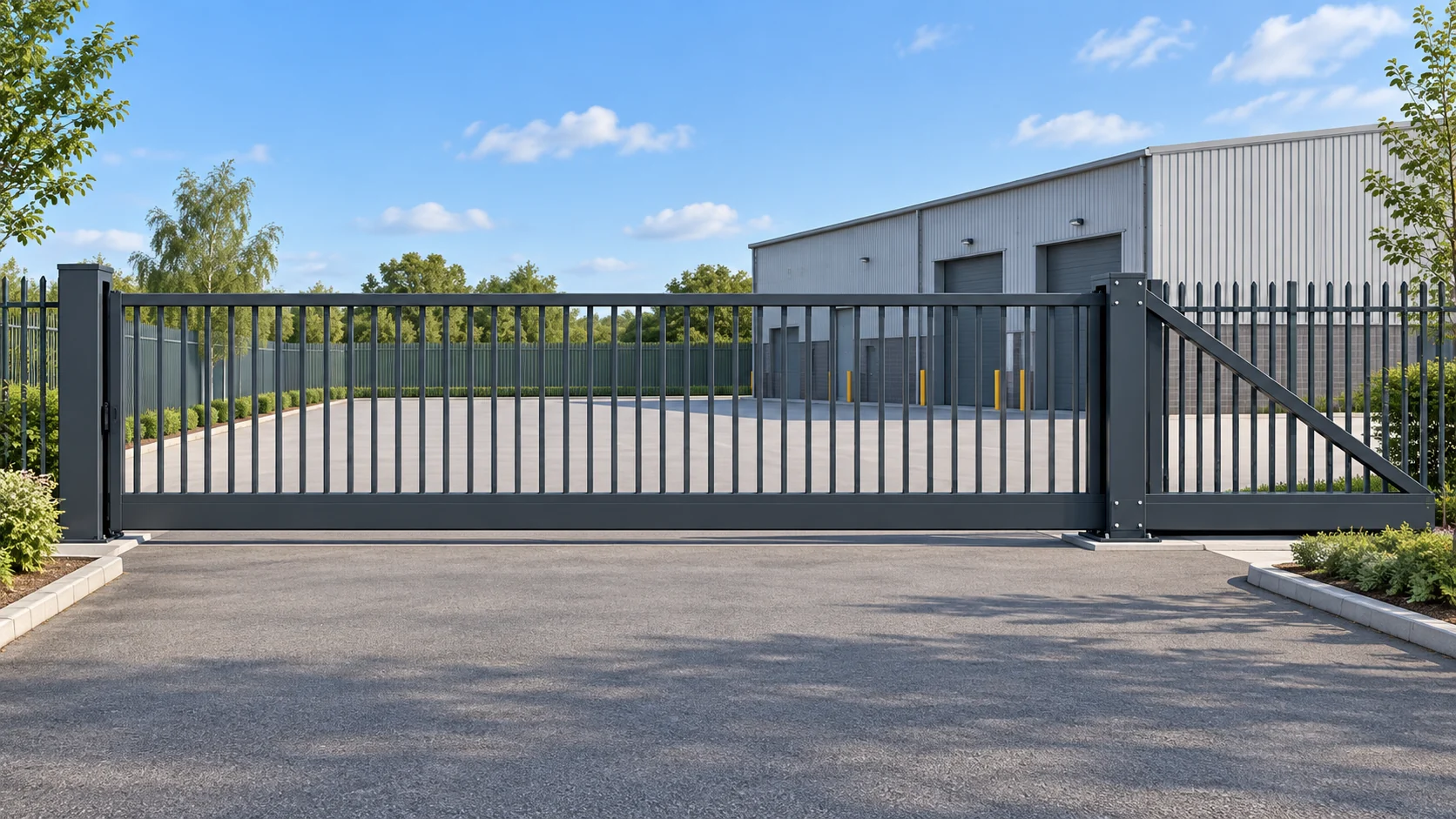
Cantilever, tracked, telescopic or bi-parting
The first decision is how the gate is supported, and that’s mostly decided by how much space you have beside the opening.
Cantilever gates hang from two roller carriages fixed to a concrete foundation beside the opening. Nothing touches the ground across the entrance itself. Lorries cross a clean threshold, and grit, ice and debris can’t stop the gate. To balance, the gate needs a tail behind the opening, usually around 40 to 50 percent of the opening’s width. An 8-metre opening therefore needs roughly 12 metres of straight, level fence line for the gate to slide back along. Cantilever is the first choice for most commercial sites where that space exists.
Tracked gates run on wheels along a steel rail set into or bolted onto the ground. They only need side space roughly equal to the opening, so they fit where a cantilever won’t. The catch is the track itself. It has to be kept clear and needs drainage, and on sites with heavy plant, loose aggregate or frequent ice it becomes the weak point.
Telescopic gates split into two or more leaves that slide over each other. That roughly halves the side space needed, which helps on tight London plots where the boundary turns a corner or meets a building close to the entrance.
Bi-parting gates use two sliding leaves meeting in the middle. They suit very wide openings, or sites with space on both sides of the entrance but not enough on either side for a single gate.
Motors, speed and duty
A commercial sliding gate typically weighs anywhere from 500 kg to over two tonnes, depending on width, height and infill. The motor is chosen by two numbers. One is the maximum gate weight it can drive. The other is its duty rating, meaning how many cycles an hour it can run without overheating. A motor sized for a domestic drive on a busy commercial entrance burns out, often within months.
For busy sites we use three-phase motors with inverter (variable-speed) drives. These start and stop the gate gently, which takes the shock out of the rack, rollers and frame, and they can run the gate faster through the middle of its travel. Lighter-use sites can run on single-phase power. If your site doesn’t have a three-phase supply near the entrance, the survey flags it early, because it affects both cost and programme.
The drive rack should be galvanised steel on any commercial gate. Nylon racks are fine on light domestic gates but wear quickly under heavy loads.
Infill and wind
Open infill such as 358 anti-climb mesh, steel palisade or vertical bars keeps the gate light and lets wind pass through. Solid cladding gives privacy and hides the yard, but it turns the gate into a sail. A solid 10-metre gate in an exposed position puts large sideways loads on its posts and rollers, so it needs a heavier structure and motor. If you want screening, perforated or louvred panels are often a better compromise than fully solid sheeting.
Safety
Sliding gates are dangerous in two places: the closing edge, where the gate meets the catch post, and the points where it slides past fixed posts and rollers, where hands and arms can be drawn in. Every gate we install has safety edges on the leading and trailing edges and photocells on both sides of the opening. Mesh is covered with fine guarding where the gate passes the posts. Closing forces are tested and recorded against BS EN 12453. A powered commercial gate must also meet the product standard BS EN 13241 and be supplied with the matching UKCA or CE marking and declaration. Ask for those documents from any installer.
The HSE’s guidance on powered gates makes clear that whoever controls the site is responsible for keeping a powered gate safe. Regular servicing with written records is how you show you’ve done that.
Groundworks and installation
A cantilever gate stands on a reinforced concrete foundation beam that carries the whole weight of the gate on two points. Getting it level and the right size matters more than anything else on the job. We also lay ducting for power and control cables, plus drainage for tracked gates. London sites often have shallow services, so we scan for buried cables and pipes before digging.
Installation usually takes two visits. The first covers groundworks and foundations. The second, about a week later once the concrete has cured, is for hanging the gate, fitting the motor and commissioning. On sites that have to stay operational, the old gate or temporary fencing stays in place until the new gate is working.
Upgrading an existing sliding gate
Plenty of commercial sliding gates have a sound frame but a tired or underpowered motor, worn rollers, or no modern safety devices. In those cases, a new motor, new carriages and safety edges can give the gate years more life for a fraction of the cost of a replacement. Where the structure itself is failing, or a tracked gate keeps jamming, we’ll tell you so. A replacement cantilever gate is often cheaper over five years than repairing an unsuitable gate again and again. For faults on a gate you already have, see gate repair and servicing.
Access control
Sliding gates work with every type of access control: ANPR for fleet and staff vehicles, fobs and cards, video intercoms for visitors (with a second cab-height panel for lorry drivers), and GSM phone entry for opening from a mobile. For broader planning of security, traffic and pedestrian routes on an industrial site, see industrial security gates.
Cost of heavy-duty commercial sliding gates in London
As a rough guide, a powered cantilever gate for a 6-metre opening typically costs £10,000 to £18,000 installed. Openings of 10 metres and over usually run from £18,000 to £35,000, depending on height, infill, groundworks and power supply. Tracked gates generally come in somewhat cheaper. Replacing the motor on a sound existing gate is usually £2,500 to £6,000. Every quote is itemised and fixed in writing after survey.