
Two kinds of GSM system
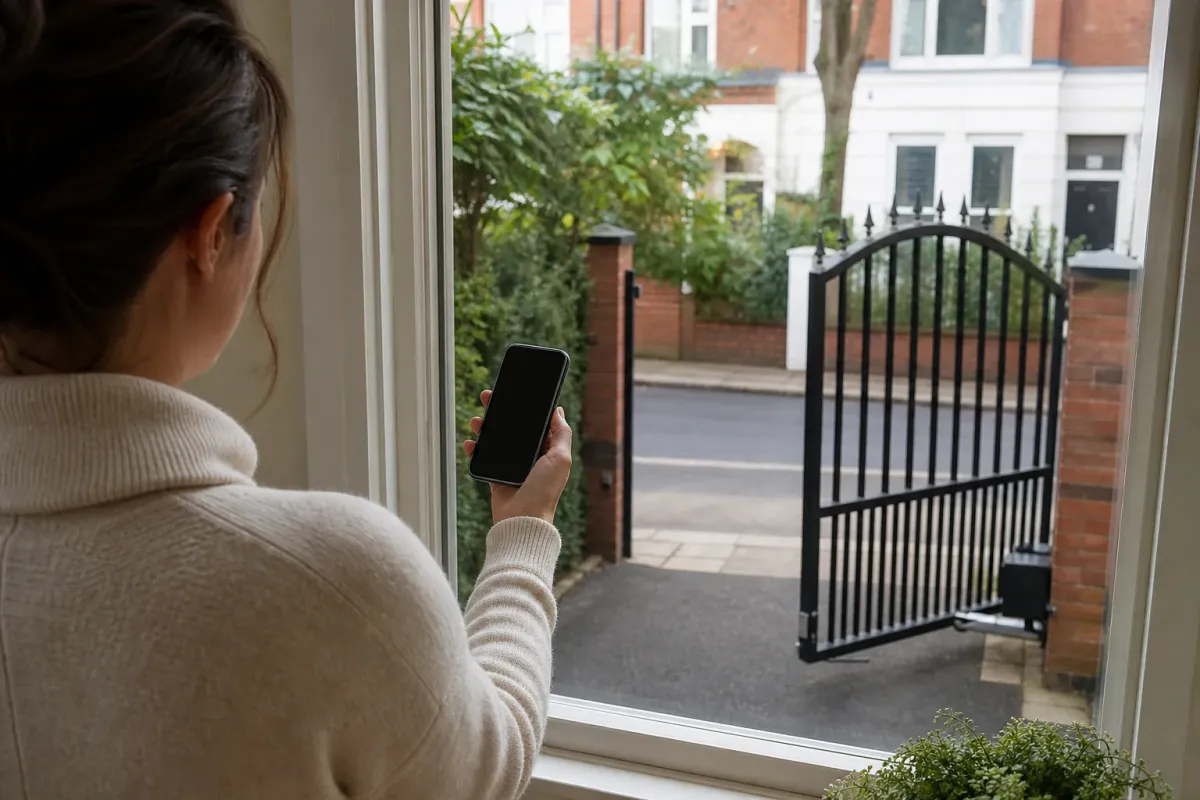
A GSM gate opener is a small unit wired into the gate’s control panel. You store a list of authorised phone numbers in it. When one of those numbers calls the unit, it recognises the caller ID, rejects the call and opens the gate. The call is never answered, so it normally costs the caller nothing. Calls from unknown numbers are ignored. It’s the simplest and cheapest way to give lots of people keyless access.
A GSM intercom adds a call panel at the gate for visitors. When someone presses the button, the unit rings your mobile (and then other numbers in turn if you don’t answer). You talk to the visitor and press a key on your phone to open the gate. Most GSM intercoms also work as an opener for authorised numbers. Video versions send a live picture to an app on your phone; see video intercoms.
Managing who can get in
Depending on the model, a GSM unit holds anywhere from a few hundred to several thousand phone numbers. Better units let you restrict numbers to set days and times (a cleaner on Tuesday mornings only), set numbers to expire on a date, and keep a log of who opened the gate and when. Most are managed by text message, a phone app or a web portal, so you can add or remove someone in seconds from wherever you are. When a carer or tenant leaves, you delete their number and their access stops immediately.
Some units can also tell you whether the gate actually opened. They do this by connecting to the gate’s position sensor and texting you a confirmation. That’s worth having if you open the gate remotely for deliveries and can’t see it.
The network switch-off
“GSM” originally meant the 2G mobile network, and many gate units still run on it. UK networks have now switched off 3G, and 2G will follow. The government’s agreement with the operators keeps 2G running until 2033 at the latest, but some services may wind down sooner. A unit bought today should be a 4G model, ideally one that supports voice calls over 4G (VoLTE), so it isn’t left stranded when older networks close. If you have an older 3G unit, it has almost certainly already stopped working. Ofcom’s switch-off guidance has the background.
SIM cards and running costs
The unit needs a SIM card that supports the services it uses: voice calls for opening and intercom calls, and texts for programming and alerts. Data is also needed for app-based models. A cheap SIM-only contract of a few pounds a month is the most reliable choice. Pay-as-you-go SIMs work, but many networks deactivate them if they’re not topped up or used for several months. A pay-as-you-go SIM in a gate that’s only opened by free rejected calls can quietly expire. Auto top-up avoids that. Intercom calls to your mobile come out of the gate SIM’s allowance, so busy entrances need a plan with enough minutes.
We record who owns the SIM and the admin account at handover. That way, if you move house or change installers, control of the system goes with the property and not with whoever set it up.
Signal, power and reliability
The unit only works as well as the mobile signal where it’s installed. Before installation, we test signal strength on the network you’ll use, in the exact position of the unit. A good signal on your own phone in the house is not the same test. Gate posts, metal enclosures and basement car parks can block reception. Where signal is weak, an external antenna on a short cable to a better spot usually solves it, or a different network can be used.
GSM entry doesn’t depend on home Wi-Fi or broadband, which is its big advantage over Wi-Fi gate systems. It does still need power. If the gate has battery backup, the GSM unit can usually run from it during a power cut. For the rare network outage, keep a remote or keypad as a backup way in. See keypad entry.
Security
GSM entry is as secure as the phones on its list. Keep the list up to date and remove numbers as soon as someone no longer needs access. Caller ID can in principle be faked, so for higher-security properties choose a unit that can require a PIN code during the call, or app control with proper log-in. Pairing GSM with a video intercom means you can see who you’re letting in rather than relying on a voice.
Where GSM works well
GSM entry suits homes with lots of regular visitors, holiday lets and Airbnb properties, where guest numbers can be added for the length of a stay. It’s also popular for elderly relatives with carers visiting at different times, shared driveways and small blocks of flats, and rural or outbuilding gates where broadband doesn’t reach. It works with any modern electric gate or barrier, including swing gates, sliding gates and car park barriers.
Cost of GSM phone entry in London
As a rough guide, a 4G GSM gate opener added to an existing electric gate typically costs £400 to £900 installed. An audio GSM intercom with a call panel is usually £900 to £1,800, and a 4G video intercom with app control £1,500 to £3,000. Add the SIM plan, usually a few pounds a month. Extra cabling, antennas and battery backup are itemised in the quote. Established makers such as AES, Videx and 2N all offer UK-supported 4G units.