The main hardwoods for gates
European oak is the traditional choice and the most asked for on period homes. It’s strong, naturally durable and has the classic straight grain with silvery flecks. For gates we use kiln-dried oak, not green (freshly sawn) oak. Green oak is cheaper but shrinks and twists as it dries, which is fine for a rustic barn but not for a pair of gates that need to meet neatly in the middle. Oak is rich in tannins, which react with ordinary steel and leave black stains, so all fixings and ironmongery should be stainless steel or galvanised. Tannins also wash out in the first few months and can mark pale paving below the gate. Rinsing the gate down a few times after installation helps.
Iroko is often called “poor man’s teak”. It’s naturally oily, very durable and more stable than oak, so it’s less prone to movement and surface cracking. It starts a golden yellow-brown and darkens to a deep brown. It’s usually cheaper than oak and suits both traditional and contemporary designs, including horizontal slatted gates.
Sapele has the reddish-brown colour and fine grain of mahogany. It’s stable, machines cleanly and takes a finish beautifully, which makes it a good choice for formal, highly finished gates. It’s a little less durable than iroko, so it relies more on a well-maintained finish.
Idigbo and meranti are budget hardwoods. Idigbo is pale and reasonably durable, but stains with iron like oak does. Meranti quality varies a lot from batch to batch. Both are a step up from softwood, though we’d usually point anyone spending real money towards oak, iroko or Accoya.
Accoya often comes up in the same conversation. Strictly, it’s not a hardwood. It’s a modified pine that is more stable and durable than most hardwoods and ideal for painted gates. See our Accoya guide and the main wooden driveway gates page.
Where the timber comes from
Every hardwood we use comes with FSC or PEFC certification, which shows it was grown and harvested responsibly. Under the UK Timber Regulations, suppliers must also show the timber was legally harvested. This matters most with tropical hardwoods like iroko and sapele. If a quote is suspiciously cheap, ask where the timber came from.
How hardwood gates are built
Hardwood’s weight is both its strength and its challenge. A solid oak driveway leaf can easily weigh 120 kg or more. Unless the gate is built to carry that weight, it will sag at the latch end within a few years.
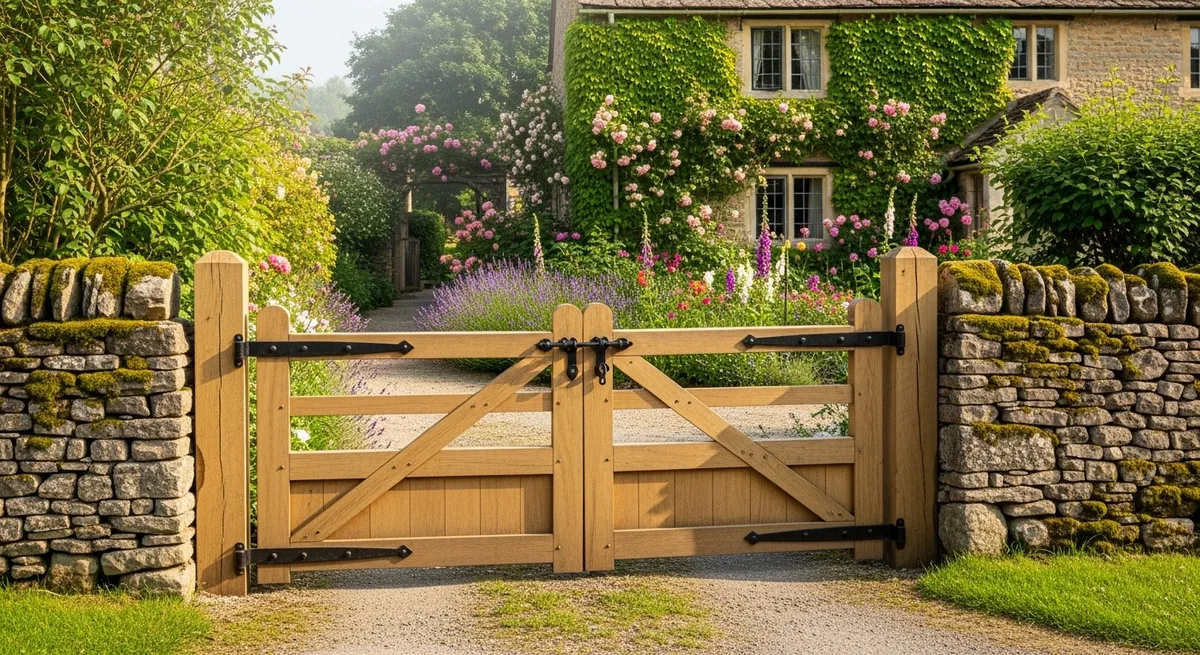
A properly made hardwood gate has a frame joined with mortise and tenon joints, glued and secured with hardwood pegs. Diagonal braces run upwards from the bottom hinge towards the latch side, carrying the weight back to the hinges. Stiles (the vertical frame members) are often laminated, built up from bonded layers so they resist twisting, which matters most on gates that will be automated. Infill boards are tongue-and-groove or properly spaced, so they can move with the seasons without splitting the frame. On very wide or heavy gates, a hidden galvanised steel frame inside the timber takes the structural load entirely.
Posts, hinges and fittings
Heavy gates need heavy supports. Hardwood posts should be substantial (typically 200 to 250 mm square for driveway gates), set deep in concrete, and ideally kept off direct ground contact with a steel post shoe so the base doesn’t rot. On brick piers, hinges are fixed into sound brickwork with resin anchors. Old piers often need repairs or rebuilding before they’ll carry a hardwood gate, and we check that at survey.
Use adjustable, bolt-through hinges, so the gate can be realigned if it settles. On a drive that rises behind the gate, rising butt hinges or careful hinge positioning lift the leaf as it opens so it clears the slope. Alternatively, a sliding gate avoids the problem entirely.
Manual gates need the right fittings to be practical day to day. That means a drop bolt into a ground socket to hold one leaf shut, a central stop for the leaves to close against, ground-mounted holders or hooks to keep the gates open in the wind, and a good lock or padbolt. Getting these right is the difference between a gate you’re happy to use and one you leave open because it’s a nuisance.
Finishes
Hardwood gives you a genuine choice. A hardwood oil or UV-filtered translucent stain keeps the warm colour and shows the grain. On an exposed south-facing gate, expect to re-coat every year or two. Sheltered gates go longer. The surface just needs cleaning and a fresh coat, not stripping. Iroko’s natural oils can stop some coatings bonding properly, so use a product designed for oily hardwoods.
Leaving the gate unfinished lets oak and iroko weather naturally to a soft silver-grey. This is the lowest-maintenance option, because the timber’s natural durability protects it. Just accept some surface checking (fine cracks) and a change of colour within the first year or two.
Paint is possible on hardwood but rarely the best use of it. If you want a painted gate, Accoya generally holds paint longer and costs less than painted oak. Accoya publishes care guidance for its own timber. For hardwoods, follow the coating manufacturer’s instructions.
Whatever finish you choose, it should be applied in the workshop to every surface, end grain included, before the gate is hung.
Automating hardwood gates
Hardwood gates automate well, but they need more from the motor than lighter gates. The motor must be sized for the leaf’s weight and the wind load on a solid boarded gate, not just its width. Hydraulic and heavy-duty electromechanical rams and underground motors all handle hardwood comfortably when correctly specified. Motor brackets should be through-bolted with backing plates, because screws alone eventually pull out of the timber. An electric lock helps hold heavy leaves closed against wind. See electric swing gates. To motorise an existing hardwood gate, see our retrofit automation service. We’ll check that the frame, hinges and posts are up to it first.
Planning permission
Gates next to a road or footpath can usually be up to 1 metre high under permitted development rules. Taller gates need planning permission, and conservation areas and listed buildings have stricter controls. Hardwood gates are often well received by conservation officers on period properties. See our borough planning guides.
Cost of hardwood driveway gates in London
As a rough guide, a pair of iroko or sapele driveway gates typically costs £3,000 to £6,500 supplied and fitted, and oak usually £4,000 to £8,000, depending on width, height and design. Large or highly detailed bespoke gates can be £8,000 to £12,000 or more. Automating heavy hardwood gates usually adds £3,000 to £7,000. New posts, pier repairs and old-gate removal are quoted separately. Our cost guide explains how to compare quotes.