
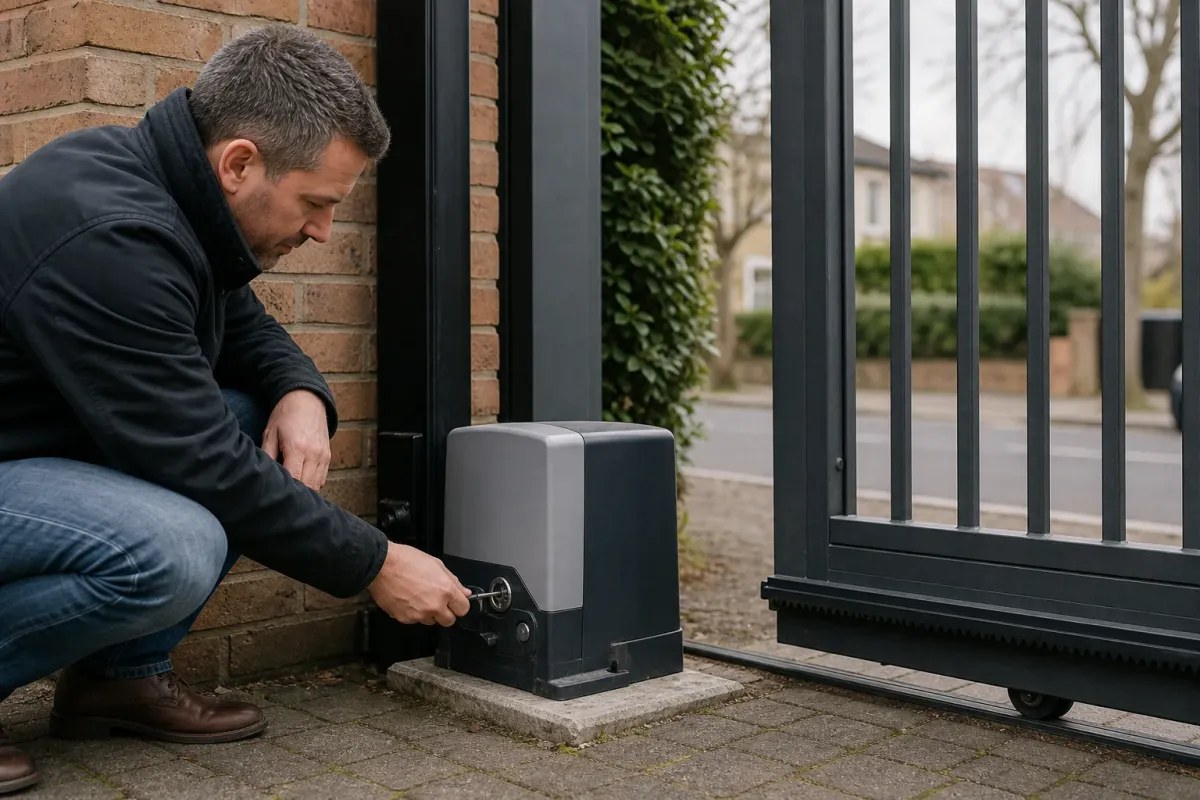
Start with the instructions supplied for your gate
Manual release arrangements differ between operators. Find the user instructions for your installed system and the release training provided at handover. Check the model from records or an identification label only where you can see it safely.
This guide cannot supply a universal key direction, cover-opening sequence or release position. If the instructions or key are missing, contact the installer or a competent gate engineer before attempting to release the mechanism.
Check whether releasing it could allow uncontrolled movement
Keep people, pets and vehicles away from the gate’s movement area. A gate freed from its drive may move because of a slope, wind or its own weight. Damage to hinges, supports or running gear can make manual movement unsafe.
Do not release a leaning, derailed, damaged or unstable gate. If you cannot control and secure it using the supplied instructions, keep clear and seek assistance. If someone is trapped or faces immediate danger, call the emergency services.
Locate the release without dismantling the operator
A surface-mounted operator may have a release on its housing. An underground swing-gate system may use a release arrangement near the gate or foundation box. A sliding system may have a release associated with its operator. The exact location and access method depend on the product.
Use the manufacturer’s diagram for your model. Do not open electrical enclosures, remove guards or disconnect drive components to search for a release. A key from another system may not fit or operate it correctly.
Follow the model-specific isolation and release sequence
Follow the supplied instructions for isolating power and preventing automatic operation before release. A mains power cut does not establish that every part is unpowered: the installation may have a backup battery or another supply.
Only operate the release and move the gate if the instructions and conditions allow you to do so safely. Use the specified method of holding or securing it. Do not force a seized key, lever or gate. Stop if movement is uneven, unexpectedly heavy or uncontrolled.
Before returning to automatic operation
Use the manufacturer’s instructions for securing the gate, re-engaging the drive and restoring operation. Keep the movement area clear. If the original problem was a mechanical fault rather than a power cut, restoring the supply does not resolve it.
If you are unsure whether the mechanism has re-engaged or the gate behaves differently, stop using it and arrange an assessment. Do not bypass sensors or repeatedly trigger the motor to make it reconnect.
Prepare for the next power interruption
Keep the correct key accessible to authorised users and store the instructions where they can be found. Ask the installer to demonstrate release and explain when it must not be attempted. Agree how people can use the entrance during a fault.
Backup capacity depends on the product, battery condition, accessories and use. Ask for the actual specification rather than a fixed cycle count. For a stuck mechanism, request gate repair assistance. See HSE guidance on responsibilities for user information and release arrangements.