
Types of barrier
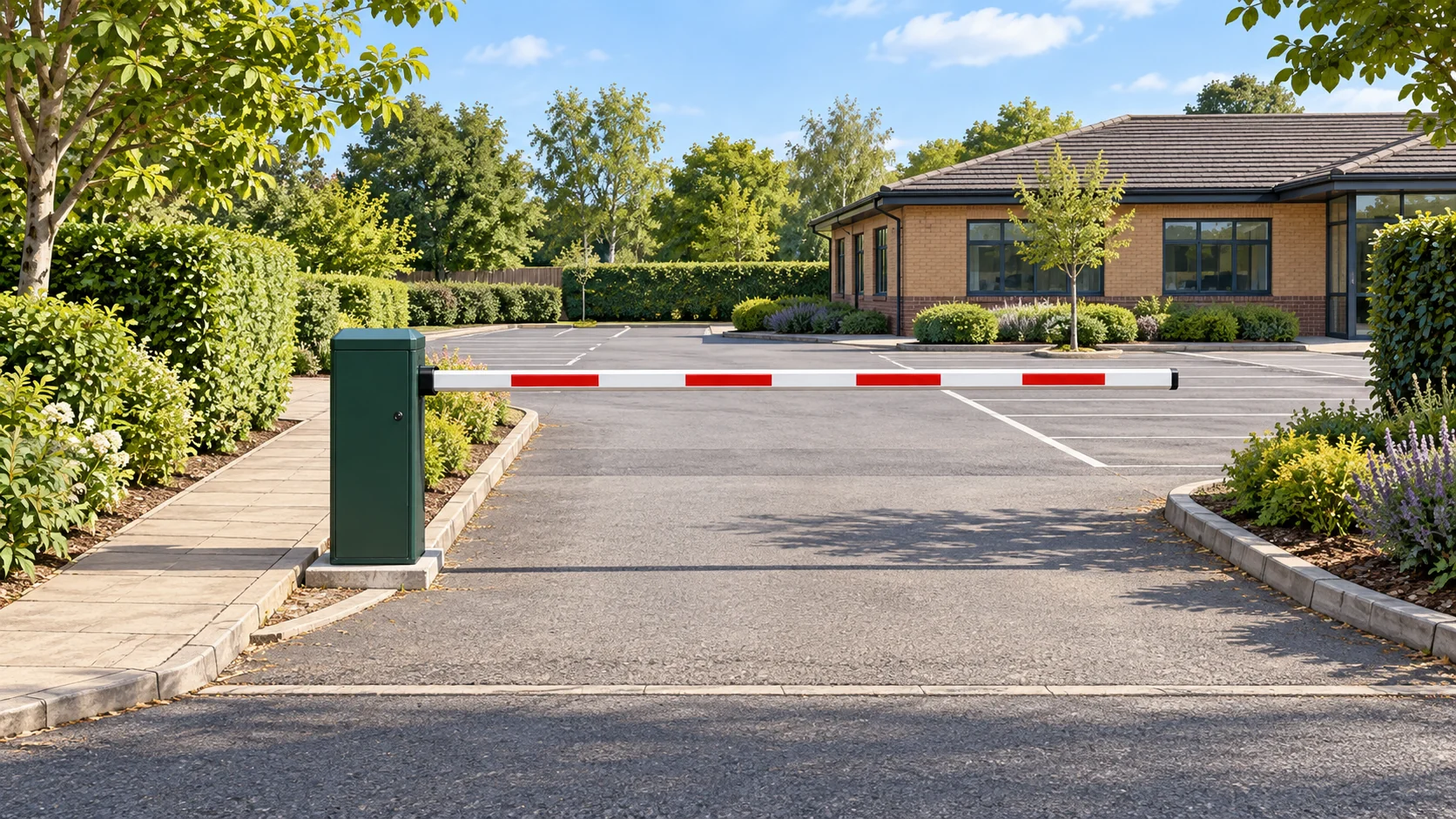
A standard boom barrier has a single straight arm, typically 3 to 6 metres long, and suits most surface car parks. It’s the cheapest and simplest option, and a good barrier opens in around three to six seconds.
High-speed barriers open in a second or two. They’re for busy entrances where a queue would otherwise back up onto the road, such as staff car parks at shift change and retail sites at peak times.
Folding-arm barriers have a hinged arm that folds as it rises, so it fits under a low ceiling. They’re the usual answer for underground and multi-storey car parks with limited headroom, often paired with a height-restriction bar at the entrance so oversized vans don’t hit the structure.
Skirted barriers have a hanging mesh or rail skirt below the arm, which stops pedestrians, cyclists and mopeds slipping underneath. They’re useful where the barrier is the only control on the entrance.
For higher-security sites, rising bollards or road blockers stop a vehicle physically rather than just signalling it to stop. They cost considerably more.
How vehicles are detected
Most barriers rely on induction loops: wire loops cut into the road surface that sense the metal of a car above them. A safety loop under the arm stops it coming down onto a vehicle. An exit loop can lift the barrier automatically for cars leaving the site, so nobody needs a fob to get out. A closing loop lowers the arm as soon as each car has passed, which cuts down tailgating. Photocells add a second layer of protection, especially for higher vehicles and pedestrians.
How drivers get in
ANPR (automatic number plate recognition) reads the number plate and lifts the barrier for registered vehicles. There’s nothing to hand out, and visitors can be pre-registered through an online portal by reception or residents. It needs a well-positioned camera and good lighting, and it struggles with dirty or non-standard plates. Most sites keep a back-up method alongside it. See ANPR systems.
Long-range tags stick to the windscreen and are read from several metres away. They’re very reliable and fast, so they suit staff and residents who arrive every day.
Proximity fobs and cards are read by a post-mounted reader at window height. They’re cheap and easy to manage, but the driver has to stop and reach out.
Intercoms let visitors and delivery drivers call reception, a concierge or a remote monitoring service, who then lifts the barrier. A video intercom lets staff see who they’re letting in. GSM phone entry lets authorised users open the barrier by calling it from their mobile.
On pay-to-park sites, ticketing and payment are handled by specialist parking management systems. We install and maintain the barriers and detection and work alongside the payment provider you choose.
Layout and queuing
The barrier should sit far enough back from the road that a car waiting at it, plus any car behind, is fully off the highway. On busy sites that may mean space for two or three cars. Reader posts and intercoms are set at driver’s-window height and positioned so the driver can reach them without leaving the car. Entry and exit lanes with a central island are easier to manage than a single shared lane. People on foot should have their own route beside the barrier, not one that crosses in front of a moving arm.
ANPR and your data
Number plates are personal data, so an ANPR system brings legal duties under UK GDPR. You’ll need signs telling drivers that ANPR is in use, a clear policy on how long plate data is kept, and someone responsible for who can see it. We set the system up with sensible retention settings and can advise on signage. The legal responsibility sits with the site operator.
Barrier or gate?
A barrier controls vehicles but doesn’t secure a site. Anyone on foot can walk round it, and a determined driver can drive through it. Many sites use a barrier for the working day and a sliding or swing gate to lock the car park at night. If you need to keep people out as well as cars, see industrial security gates or heavy-duty sliding gates.
Installation
A barrier is bolted to a concrete base, with ducting for power and control cables. Induction loops are cut into the road surface and sealed. Most single-lane installations take one day on site, with the entrance closed for part of it. We plan the work for quiet periods, evenings or weekends where the car park can’t close during the day. At handover, the site team is shown how to manage users, release the barrier by hand, and what to do if the arm is hit.
Powered barriers come under the same safety standards and HSE guidance as powered gates. That means safety loops and photocells, recorded safety tests, and regular servicing.
Cost of car park barriers in London
As a rough guide, a standard barrier with induction loops and a fob reader typically costs £3,000 to £6,000 installed, per lane. High-speed and folding-arm barriers usually cost £5,000 to £9,000. Adding ANPR is typically £2,500 to £6,000 per lane, plus an ongoing software or support subscription on most systems. Look at the running costs too: replacement fobs or tags, SIM connectivity for intercoms and GSM units, software licences and service contracts. Every quote sets these out separately, so you can compare like with like.
Servicing and damage
Barriers on busy car parks cycle hundreds of times a day and should be serviced two to four times a year. Arms do get hit. A good barrier has a breakaway arm fixing that protects the motor when that happens, and keeping a spare arm on site means the entrance is back in use the same day. For a barrier that’s already faulty, see gate repair and servicing.