
How it works
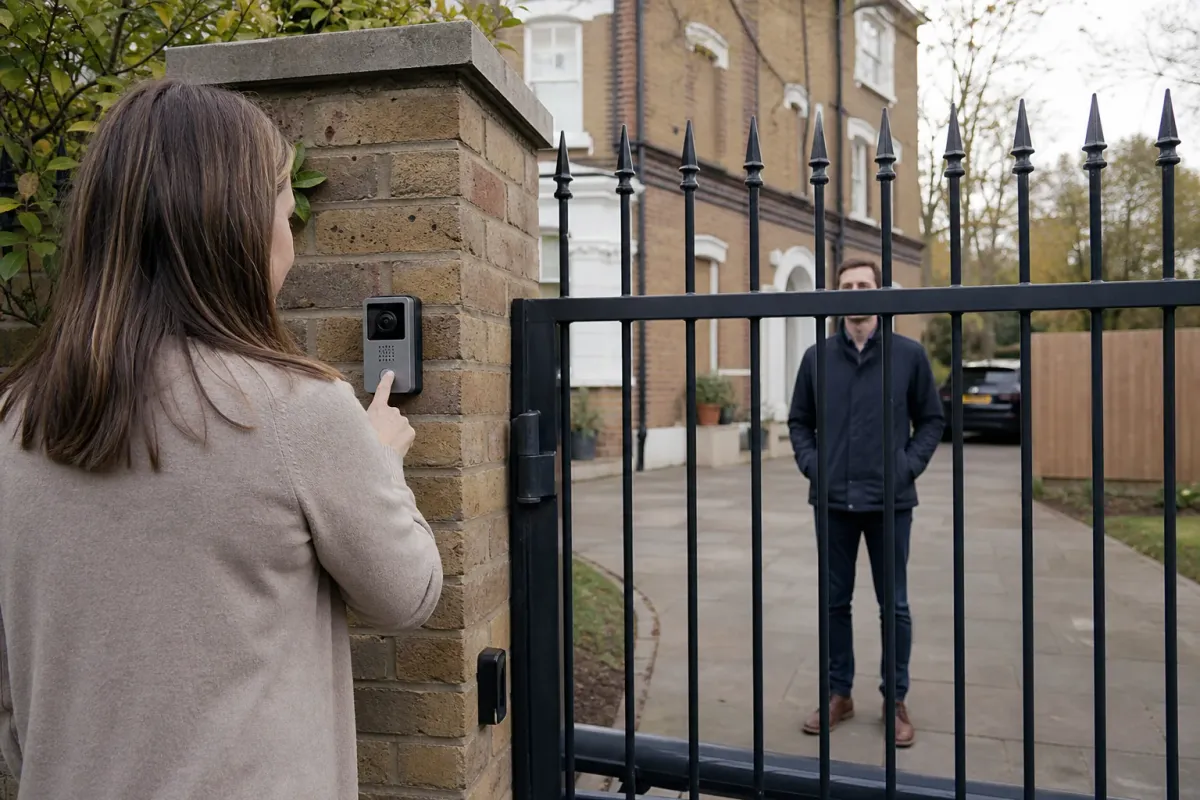
A visitor presses the call button on a panel at the gate. The panel has a camera, microphone and speaker. The call rings on one or more screens inside the house and, on most modern systems, on your phone through an app. You see and speak to the visitor, then press a button to open the driveway gate, the pedestrian gate or both. The intercom simply tells the gate’s control panel to open, just like a remote. The gate’s own safety devices still control how it moves.
Types of system
Two-wire systems send video, audio and power along a single pair of cables. They’re robust and reliable over long distances, often more than 100 metres, which suits long drives. They’re also ideal where an old intercom cable already runs from the gate to the house and can be reused. Comelit, Videx and Fermax all make well-regarded two-wire ranges. Many now add app calling through a gateway unit.
IP systems run over network cable, usually a single external-grade Cat6 cable carrying data and power (Power over Ethernet) up to about 100 metres. They give the sharpest video, app calling, multiple monitors, recording and easy integration with CCTV, and are increasingly the default for new installations. Hikvision, Akuvox, 2N and DoorBird are common choices.
Wireless and Wi-Fi systems avoid digging a cable trench, but a gate is often 20 to 50 metres from the house, sometimes behind brick walls and metal gates. Home Wi-Fi rarely reaches reliably. Where trenching isn’t practical, a point-to-point wireless link (a pair of small dishes) is far more dependable than Wi-Fi. For gates with no cable route at all, a 4G video intercom works over the mobile network instead. See GSM phone entry.
Getting the signal to the house
Most of the work in a video intercom installation is the cable route. The cable runs in a duct, usually under the drive or along a boundary, from the gate to the point where it enters the house. If you’re having the drive relaid or new gates installed, put the duct in then. It costs far less than lifting paving later. We survey the route, check any existing cables and agree where the indoor monitor and network connection will go before quoting.
The gate panel
Choose an external panel built for life outdoors on a street. It should be weatherproof (IP65 or better) and vandal-resistant, with a wide-angle camera, infrared night vision so you can see faces after dark, and wide dynamic range so a visitor isn’t just a silhouette against bright sky or headlights. Panels can include a keypad or fob reader, so the same unit handles visitors and residents.
Mount the panel at around 1.4 to 1.5 metres for people on foot. For drivers, fit a second panel on a gooseneck post at car-window height, or mount it where the driver can reach it without leaving the car or stopping across the pavement. On commercial sites, a third panel at lorry-cab height is common. See car park barriers.
Inside the house
Indoor monitors range from simple 4 or 7-inch screens to 10-inch touchscreens that can also show CCTV cameras. You can have several, such as one in the kitchen, one upstairs and one in a home office, and they can all ring together or in sequence. Monitors can also act as an internal intercom between rooms.
Answering on your phone
App calling forwards the call to your phone, so you can let in a delivery driver or cleaner while you’re out. It relies on the gate panel having a network connection and your phone getting the notification. Expect a few seconds’ delay compared with an indoor monitor, and make sure the system will still ring the indoor monitor if your broadband goes down. Some apps need a subscription for remote access or cloud recordings. We’ll tell you exactly what’s included before you buy.
Linking to the gate
The intercom connects to the gate’s control panel to open the gate. It can also connect to a second relay for an electric lock on a pedestrian gate. Most modern gate control panels from the main manufacturers accept an intercom without difficulty. Older or unusual ones sometimes need an interface or an upgrade, which we check at survey. If you want the intercom to show whether the gate is actually open or closed, that needs a gate position sensor wired back to the intercom, and not every system supports it.
Recording and privacy
Many systems save a snapshot or short video clip each time someone calls, either on a memory card in the monitor, on a recorder or in the cloud. That’s useful for checking deliveries and visitors you missed. If the camera captures images beyond your property, such as the street or a neighbour’s house, data protection law applies even at home. The ICO’s guidance on domestic CCTV explains your responsibilities. We angle cameras to cover the visitor, not the pavement opposite, and many panels let you mask out areas you don’t want recorded.
Rough costs of video intercom systems in London
As a rough guide, a two-wire video intercom with one indoor monitor, connected to an existing gate, typically costs £900 to £2,000 installed. IP systems with app calling and multiple monitors usually cost £1,500 to £3,500. Premium panels with integrated keypads, fob readers and high-end cameras run £2,500 to £5,000. Trenching, ducting and reinstating the drive are itemised separately, and any app or cloud subscriptions are shown in the quote. Our intercom buying guide and Comelit vs Hikvision comparison go into the brands in more detail.