
AUTOMATED GATES·SWING GATES·SLIDING GATES·BI-FOLD GATES·ACCESS CONTROL·FREE SITE SURVEY·ALL LONDON BOROUGHS·4.9 STAR RATED·AUTOMATED GATES·SWING GATES·SLIDING GATES·BI-FOLD GATES·ACCESS CONTROL·FREE SITE SURVEY·ALL LONDON BOROUGHS·4.9 STAR RATED·
Front Garden Paving, SUDS and the Permeable Rule Before You Fit a London Gate
Back to blog
Planning & Regulations2 July 2026

Front Garden Paving, SUDS and the Permeable Rule Before You Fit a London Gate

Paving comes before the gate, and paving has its own rules

Most London gate projects do not start with the gate. They start with the front garden, because the gate needs a driveway to close across, and turning a lawn or a tired old path into a parking space almost always means laying a hard surface first. That paving is not a free-for-all. Since 2008 the way you surface a front garden has carried its own set of rules, driven by flooding rather than by the gate, and getting them wrong can hold up the whole project or land you with an enforcement notice long after the gate is hung.

The reason is simple physics. A paved front garden sheds rainwater that a lawn would have soaked up. Multiply that across a London street where nearly every frontage has been paved over for parking, and the water has nowhere to go except the drains and, when the drains are full, the road and the ground floors. The rules exist to slow that runoff at source, and they apply to the surface you lay, not to the gate you put in front of it.

So the order of operations matters. Before you get as far as choosing a swing, a slide or a fold, it is worth settling how the frontage will drain, because that decision shapes the surface, the budget and whether you need planning permission at all. It runs alongside the separate question of highway access, because whether you need a dropped kerb for a driveway gate is decided on the council side of the boundary. The kerb is the council highway. The paving and its drainage are your land. Both have to be right before the gate earns its keep.

Free Matching Service

Ready to get driveway gate quotes?

Get matched with vetted London installers — no obligation, no cost.

The permeable rule and the five square metre threshold

The core of it is a change to permitted development rights that took effect on 1 October 2008. From that date, laying more than five square metres of hard surface in a front garden needs planning permission if the surface is impermeable and the water has nowhere permeable to drain. Below five square metres you are clear, and above it you are clear too as long as you build permeability into the design. The threshold is small; five square metres is barely enough for a single car, so almost every real London driveway is over it.

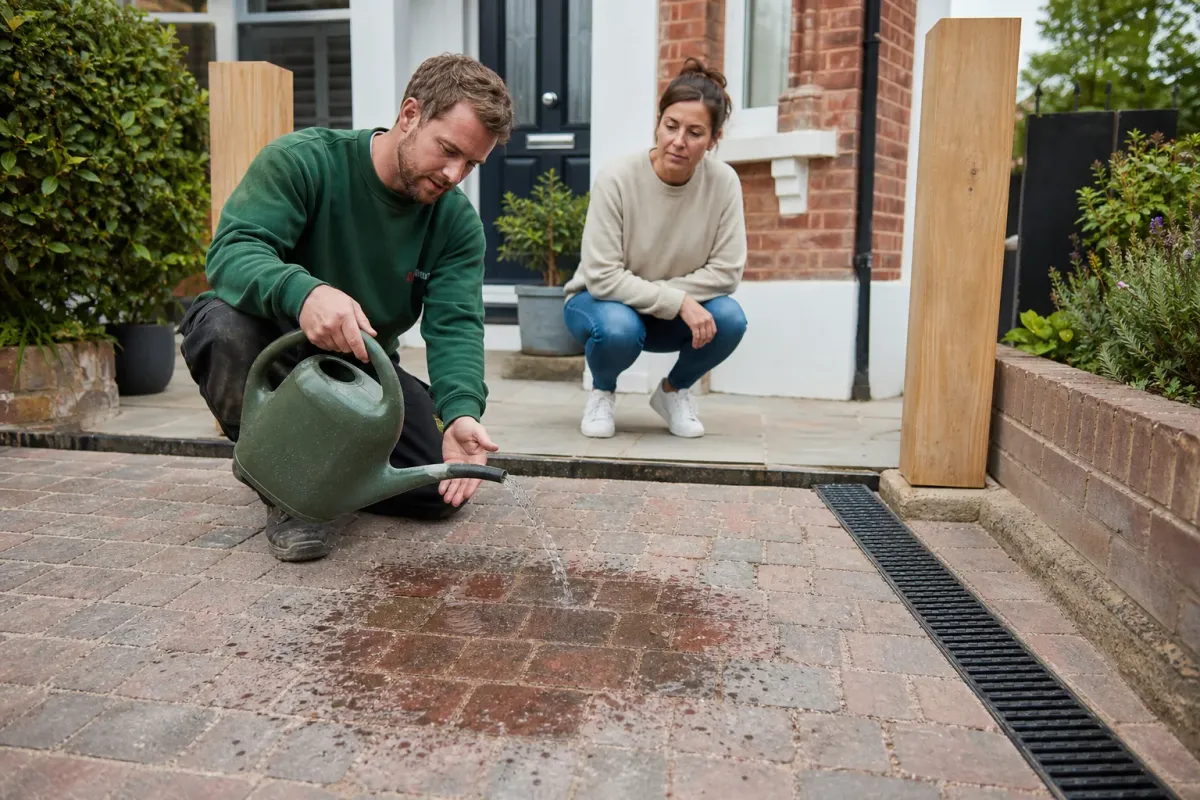
That sounds restrictive until you read the exemption, which is where most driveways actually live. You do not need permission at all, at any size, if the surface is permeable or if the rainwater is directed to a permeable area rather than the drains. The government guidance on the permeable surfacing of front gardens spells out the qualifying materials: gravel, permeable concrete block paving, and porous asphalt among them. Lay one of those, or drain a conventional surface to a border or soakaway, and the five square metre threshold never bites.

Put plainly, you have two routes to a legal frontage. Use a porous surface so the water passes straight through it into the ground, or use a solid surface and give the water somewhere permeable to go. Only the third option, a large impermeable surface draining onto the highway, needs a planning application, and it is also the option most likely to be refused. The Planning Portal sets out the same test in its guidance on planning permission for paving a front garden, and it is the test a London planning officer will apply if a neighbour reports a frontage that floods the pavement.

What SUDS actually means on a normal driveway

Sustainable drainage systems, usually shortened to SUDS, sounds like something reserved for large developments, but on a single driveway it comes down to a handful of practical choices. The idea is to manage rainfall where it lands instead of piping it straight to the sewer, and a front garden has several ways to do that without any exotic engineering.

  • Permeable block paving: special blocks with wider joints filled with grit, so water drains through the gaps into a stone sub-base and then the ground.
  • Resin bound gravel: a porous poured surface that lets water through while staying smooth enough to sweep and park on.
  • Loose gravel: the cheapest permeable option, though it needs edging and the occasional top-up, and it is less friendly to a gate track laid across it.
  • A drainage channel to a border or soakaway: keep a solid surface if you prefer, but fall the water into a planted strip, a rain garden or a soakaway pit rather than the road.

Which one suits you depends on the surface you want underfoot and how much of the frontage is going under. A soakaway is a stone-filled pit that holds a downpour and lets it seep away slowly, and it is the usual answer when a homeowner wants a solid, easy-clean surface but still has to satisfy the rule. A rain garden or a planted border does the same job with more greenery and less digging. None of these is expensive relative to the paving itself, and building one in from the start is far cheaper than being told to retrofit drainage after a complaint.

There is a gate detail worth flagging here too. If you go for loose gravel, a ground-running sliding gate does not sit well on it, because the track needs a firm, level bed. On a permeable or resin bound surface a track can be set into a strip of solid paving, or you can sidestep the issue with a cantilever or trackless design. This is one of the reasons the surface decision and the gate decision are best made together, and the electric sliding gates options for tight London frontages assume a properly prepared base rather than raw gravel.

Where London adds its own layer

The permeable rule is national, but London stacks extra conditions on top of it, and they are the ones that catch people out. Article 4 directions are the big one. In a growing number of London boroughs the council has removed some permitted development rights in specific streets to protect their character, and that can pull a front garden paving job into a full planning application even when the permeable exemption would otherwise cover it. If your street is under an Article 4 direction, assume nothing about front garden works until you have checked. The scope of those directions and how they affect gate and frontage plans is covered in the piece on Article 4 directions and gate planning permission.

Conservation areas add another. Roughly a third of London sits within one, and while paving is not automatically banned there, the council takes a keener interest in materials and appearance, and a stark expanse of grey block paving in a Victorian terrace conservation area is more likely to draw objection than a gravel or reclaimed-stone finish. Trees are a third factor. A protected tree in or near the front garden can restrict how close you dig and what you surface over its roots, quite separately from the drainage rule.

For the specific borough tests, the sensible first stop is your own council rather than a neighbour or a contractor, because two houses on the same street can sit under different rules. Our borough-by-borough notes on London local planning and highway rules are a useful orientation before you make that call, so you know which questions to ask about Article 4 status, conservation designation and any tree protection on your frontage.

Cost, sequencing and getting it right once

As an indicative guide, permeable surfacing in London tends to land somewhere between roughly 70 and 150 pounds per square metre supplied and laid, with loose gravel at the cheaper end, permeable block paving in the middle, and resin bound gravel towards the top. Adding a soakaway or a drainage channel to a conventional surface is a modest extra rather than a doubling of cost. These are ballpark figures and a real number comes from a survey, but they show that the permeable route is not a penalty; it is roughly what any decent driveway costs, and it keeps you clear of planning.

The saving that most people miss is sequencing. If the frontage is being dug up to lay the surface, that is the moment to run the gate power cable and set the pillar foundations, because the ground is already open. Coming back later to trench a finished driveway is expensive and leaves a scar. Doing the paving, the drainage, the foundations and the cable as one coordinated job is far cheaper than three separate visits, and it is also why a secured, well-finished frontage tends to add rather than subtract at resale, a point drawn out in the note on how a gate affects driveway gate property value in London.

When you are ready, tell us about the frontage using the quote form on this page: the rough area you are paving, the surface you have in mind, and whether the street is in a conservation area or under an Article 4 direction. We will match you with vetted London installers who fit and automate the gate and can advise on a base that satisfies the drainage rule. The paving and drainage themselves are groundworks you arrange with a driveway contractor, and we make sure the gate side is planned around a frontage that is already legal and properly drained.

Send us your frontage details using the form above and we will connect you with the right London gate installer for the entrance you are building.