
Compare timber, painted aluminium and wood-effect finishes by appearance, construction, upkeep and complete installation scope.
Choosing between aluminium and timber gates?
Tell us the appearance you want, the upkeep you can manage and your approximate opening size. Ask for comparable quotes covering the same entrance and installation scope.
In this guide11 sections
Compare samples at your property
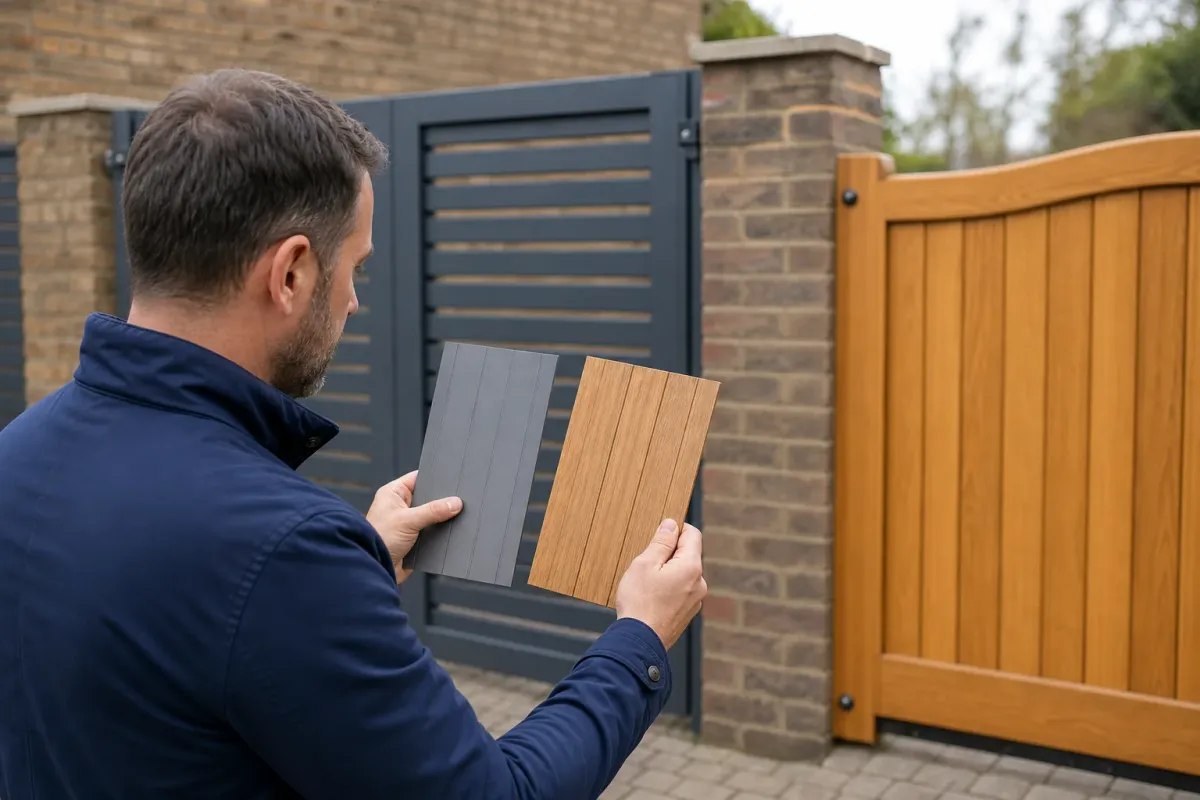
Timber has natural grain and variation; painted aluminium gives a more uniform surface. Wood-effect aluminium offers a printed or applied timber appearance, but grain repetition, edges and the rear face can look different from real wood.
View samples beside your brickwork in daylight and shade. Ask to see the finish on a corner, joint and reverse face, rather than choosing from a small photograph. Check how the posts, pedestrian gate and fencing will match.
Look beyond the face of the gate
For timber, ask for the species or modified-wood product, board construction, frame joints and finish specification. For aluminium, ask about the frame, infill, joints, coating and repair options. The material name alone does not establish stiffness, durability or suitability for automation.
Solid boards and open bars create different privacy and wind-exposure conditions. Discuss weight, dimensions, supports and movement with the installer. Compare the complete gate design instead of assuming that one material will suit every opening.
Plan the upkeep you will accept
Timber coatings need care appropriate to the species, exposure and selected finish. Ask how to recognise when attention is due and whether you want the wood to retain its original colour. Aluminium still needs the specified cleaning, coating checks and maintenance of its fittings.
Separate the timber or coating warranty from the gate fabrication, installation and automation terms. Ask about exclusions, maintenance records and labour charges. A raw-material warranty does not promise that the complete gate will remain unchanged for that period.
Compare equivalent quotations
Put the same opening dimensions, infill, finish, supports, automation and access controls into both quotations. Include removal of the old entrance, power, groundworks, VAT and reinstatement. This gives you a useful comparison without relying on a universal lifespan or percentage saving.
Explore wooden driveway gates and aluminium gates. For modified timber, read our Accoya guide and ask for the proposed product terms. Then discuss your entrance.
A practical material comparison
| Decision | Timber | Aluminium |
|---|---|---|
| Appearance | Natural grain and variation, with the chosen species, board pattern and finish. | Painted or wood-effect finish, with profiles and joints that vary by range. |
| Construction | Ask about the frame, joints, board fixing, moisture management and fittings. | Ask about frame sections, infill attachment, joints, coating and fittings. |
| Care | Obtain the specified cleaning and coating care for the wood and exposure. | Obtain cleaning, coating inspection and hardware care instructions. |
| Damage and repairs | Ask how damaged boards, joints and finishes could be repaired. | Ask whether panels can be replaced and how finish repairs are handled. |
| Automation | Assess the complete gate, dimensions, supports and operating geometry. | Apply the same complete-system assessment to the proposed design. |
| Warranty | Separate timber, fabrication, finish, fittings and installation terms. | Separate coating, fabrication, fittings and installation terms. |
Use the matrix to compare actual products. The terms wooden and aluminium cover many constructions and finishes. Neither material name gives a reliable installed price, security rating or guaranteed service life for the complete entrance.
Choose the board pattern before deciding on colour
A full boarded surface, spaced slats and an open upper section give different views through the entrance. Look from the pavement towards the house and from the house towards approaching visitors. Decide what needs screening and where visibility remains useful. Compare the rear face too, because that is the view you may see most often.
Ask for a drawing showing board widths, spacing, frame edges and the relationship between the driveway gate and any pedestrian gate. A narrow side gate may use a different arrangement of boards even when the finish matches. Check whether those differences are acceptable before fabrication.
For wood-effect aluminium, request a sample large enough to reveal repeating grain and the treatment of corners and ends. For timber, ask what variation to expect between boards and what the selected finish will look like after weathering. A small online colour swatch cannot settle those decisions.
For a period property, start with its actual boundary details rather than a rule that every older house must have timber or ornate metalwork. Where controls apply, discuss the proposed material and appearance with the relevant adviser before ordering. A convincing timber effect does not itself establish planning acceptability.
Construction matters as much as the surface
Ask the fabricator to explain how the frame supports the infill and where the hinges or running gear attach. Request the details that matter for your chosen width and height. If automation is proposed, have the gate supplier and installer agree the arrangement instead of treating a motor kit as an unrelated addition.
Discuss solid infill and wind exposure together. A gate made from a lighter material still presents a surface to the wind, and the supports and equipment need assessment for the actual design. Avoid substituting an assumed material advantage for a measured specification.
Look for a written approach to drainage and moisture around joints, board ends and fittings. Ask how the selected hardware suits the material and exterior location. These questions help compare the proposed workmanship without assuming that every gate from one material has the same construction.
If you want to keep existing posts or brick piers, include their assessment in both material quotations. A change of leaf material does not establish that the old supports or hinges are suitable for the new entrance.
Budget for the upkeep you can realistically provide
Ask each supplier for a care sheet before you accept the quotation. It should identify the permitted cleaning products, coating inspections and any specialist work. Consider access to both faces of the gate, nearby planting and the time or contractor help you are willing to allow for upkeep.
Decide whether you want timber to retain a particular colour or are comfortable with the appearance allowed by the chosen finish system. Record that preference when discussing coatings. Do not rely on a universal recoating interval taken from another species, finish or exposure.
For a coated aluminium gate, ask how to deal with a scratch, damaged edge or impact. Establish whether the supplier offers repair materials, replacement boards or a refinishing service, and request terms rather than assuming those services are included. Hardware and automation still require their own care.
For both materials, keep cleaning and service records where the terms require them. Ask who deals with a problem involving more than one supplier, such as movement that damages a finish. A long material warranty and a practical route to resolving an installation problem are different things.
Compare three choices using the same entrance brief
If your priority is natural grain and you accept the specified care, compare suitable timber constructions and finishes. Ask about species or modified timber by name and request a sample of the proposed product. Include the fabrication and coating scope so the choice is more precise than wood versus metal.
If you prefer a uniform painted appearance, compare aluminium ranges against a painted timber alternative. Keep the infill, opening layout and finish colour consistent. Ask what changes at the joints, frame edges and reverse face; those details can explain why two apparently similar gates look different in person.
If you want a timber appearance with a different care routine, put wood-effect aluminium beside a real timber sample at the property. Make the decision in daylight and shade. Check the proposed posts and pedestrian gate at the same time so you are comparing a complete frontage.
Write down the non-negotiable requirements before requesting prices: usable opening, privacy, pedestrian access, acceptable upkeep and operation. Then compare the complete installed cost and written terms. You can choose on those practical differences without relying on invented lifespan figures or promises that any material needs no maintenance.
Ask what happens after accidental damage
Consider a vehicle scraping one panel or a fitting being damaged during building work. Ask whether an individual component can be replaced, whether the original finish can be matched and who would carry out the repair. Availability and matching depend on the actual product, so request a supported repair route rather than a guarantee that a later replacement will be invisible.
Keep the approved drawing, colour reference, sample details and invoice. These records help a repair contractor identify the supplied gate and give you a clearer comparison if you later replace a pedestrian gate or extend the adjoining fence.