
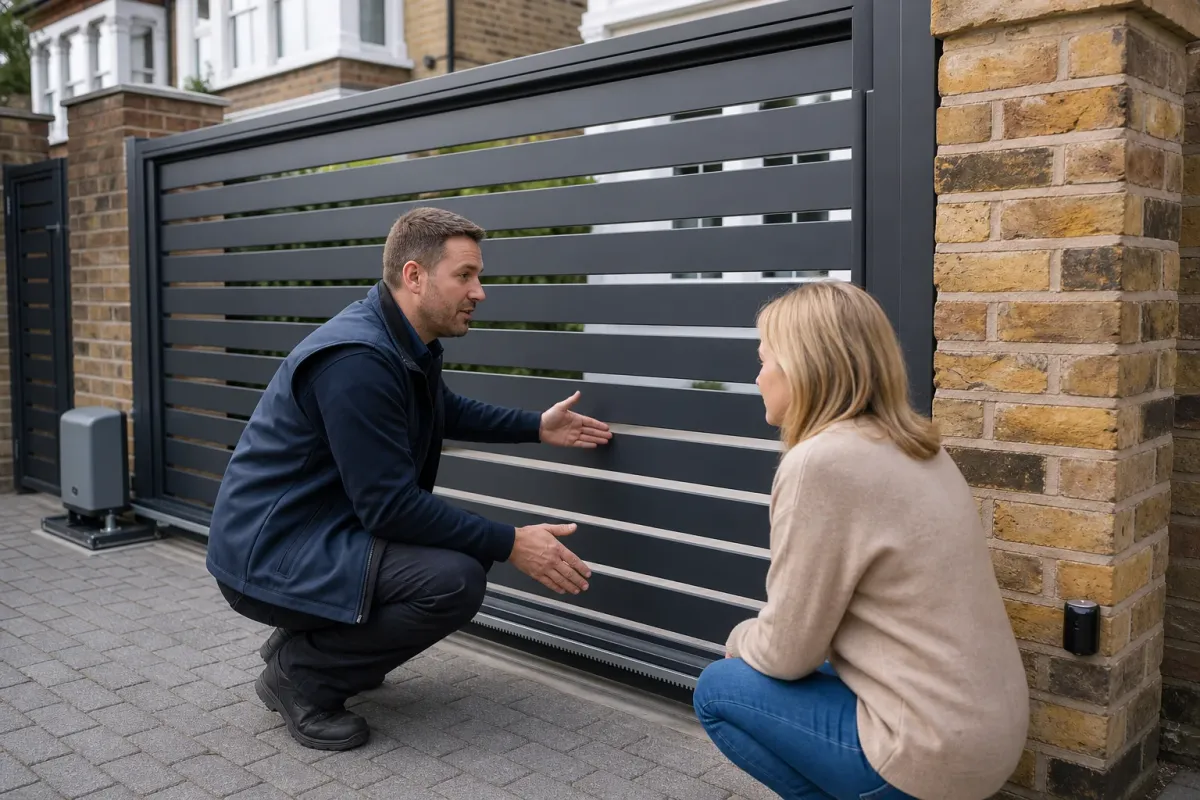
Start with the hazards at the entrance
Safety devices perform different functions. A gate can have several devices fitted and still present an unaddressed trapping or crushing risk. The installer needs to assess the complete gate, its movement, nearby structures and the people who may encounter it.
Ask the proposal to explain the risks identified and how the design addresses them. Do not treat a shopping list of sensors as a substitute for that assessment.
What photocells can detect
A photocell arrangement detects interruption of a beam or detection path. The area it covers depends on its design and positioning. A single beam does not detect every person or object anywhere around the gate.
The control system’s response depends on the equipment and configuration. Do not assume every beam interruption always causes the same stop or reversal in every operating direction. Ask the installer to explain the intended response and user checks.
What safety edges do
A suitable safety edge can detect contact along the area it protects and signal the control system. Selection, positioning, compatibility and the response of the complete system matter. Fitting an edge to one part of a gate does not establish protection at every other trapping point.
Ask which hazards the edges address and how their function will be verified. Damaged, loose or disconnected protection needs competent attention. Do not defeat a device to keep using the gate.
What vehicle loops do
An inductive loop detects a change caused by a suitable vehicle within its detection area. Depending on the design, it may form part of an access-control or vehicle-presence arrangement.
Do not rely on a vehicle loop to detect a pedestrian or provide all necessary protection. The installer must consider people on foot, cyclists, visitors and others alongside vehicle use. A convenient opening trigger and a safety function are not automatically interchangeable.
Positioning and testing must suit the system
There is no mounting height or device combination in this article that can approve every entrance. Gate geometry, surroundings, users and operating arrangements affect the specification. A competent installer needs to verify the proposed protective measures before handover.
Where force limitation is part of the protection, suitable verification is needed. Read our force-testing guide rather than attempting a test with your body or an improvised obstacle.
What owners should do when something changes
Follow the user instructions for routine checks and cleaning. Report visible damage, unexpected movement or a suspected failure of protection. Keep people clear and follow isolation instructions where you can do so safely.
Have a competent person assess faults and changes, including changes to the surrounding entrance. Keep records and ask when the gate can return to use. See HSE guidance on powered-gate safety, or request a gate assessment.