
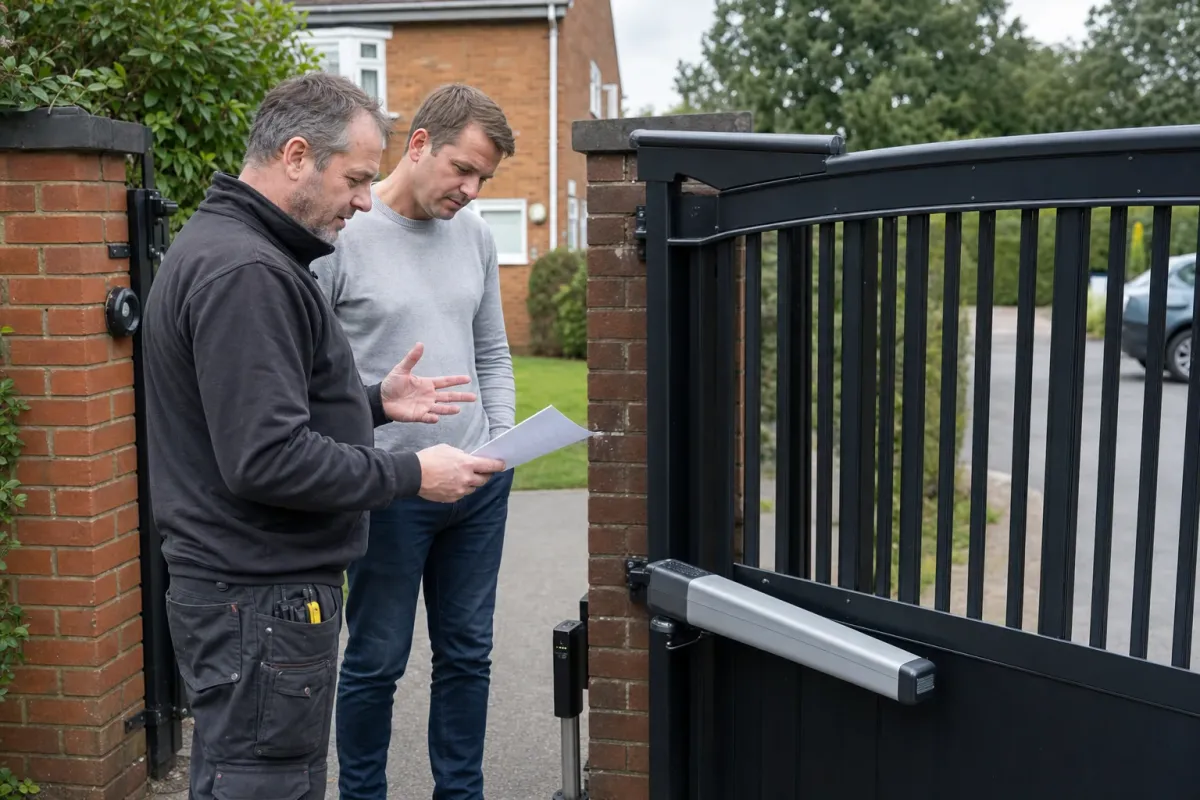
The completed entrance matters
A powered gate is a machine. Its safety depends on the assembled gate, supports, drive, controls, protective measures and surroundings. A marked motor or a list of fitted sensors does not by itself demonstrate that the complete installation is safe.
A site assessment should consider the people who can encounter the gate, including visitors and children, and the places where movement could cause injury. The proposal and handover should explain how the identified risks are addressed.
Installer and manufacturer responsibilities
HSE explains that the person assembling a powered gate from components can become the manufacturer of the completed machine. Converting an existing manual gate to power operation can also create these responsibilities.
Ask who will take responsibility for the completed installation. Request the Declaration of Conformity, user instructions and the recommended maintenance and safety checks at handover. A component manual or motor receipt is not a substitute for the documents for the assembled gate.
CE and UKCA marking in Great Britain
Do not rely on the claim that CE marking stopped being accepted for gate equipment in January 2023. Current government guidance describes CE recognition alongside or in place of UKCA for relevant product regimes in Great Britain. The applicable rules depend on the product and market.
Ask the supplier to identify the conformity route and documents for the equipment and completed installation. See GOV.UK guidance on UKCA or CE marked products. Northern Ireland has separate arrangements.
Private homes, workplaces and landlords
HSE distinguishes private domestic owners from people responsible for gates at work or as part of a work activity. Its guidance says health and safety law does not apply to owners of gates on privately owned domestic premises, while recommending regular checks. This does not remove product or installer obligations, or a householder’s potential liability for harm or damage.
Commercial owners, employers, landlords and managing agents can have duties to keep gates safe. If your entrance serves rented property, a shared development or a business, establish who is responsible for its operation, maintenance and records. Do not use advice for a single private home as the complete answer for those settings.
Testing, maintenance and changes
The installer needs to assess and check the completed system before handover. Where force limitation forms part of the protection, its performance needs suitable verification. Read our force-testing explanation for what a homeowner should ask.
Follow the installation’s instructions and maintenance recommendations. Do not assume that one annual visit or a generic device list proves continuing safety. Report damage, unexpected movement or failed protective functions and seek competent help. Significant modifications may require a new conformity assessment; straightforward servicing is not automatically the same situation.
A practical handover checklist
Ask for the gate and equipment identification, operating instructions, manual-release training, isolation information, conformity documents and the recommended checking arrangements. Keep the responsible company’s contact details and agree what to do if a fault makes the entrance unsafe.
For an existing installation with missing records, request a gate assessment. Agree what the visit can establish rather than expect a certificate from photographs. Source: HSE guidance on responsibilities.