
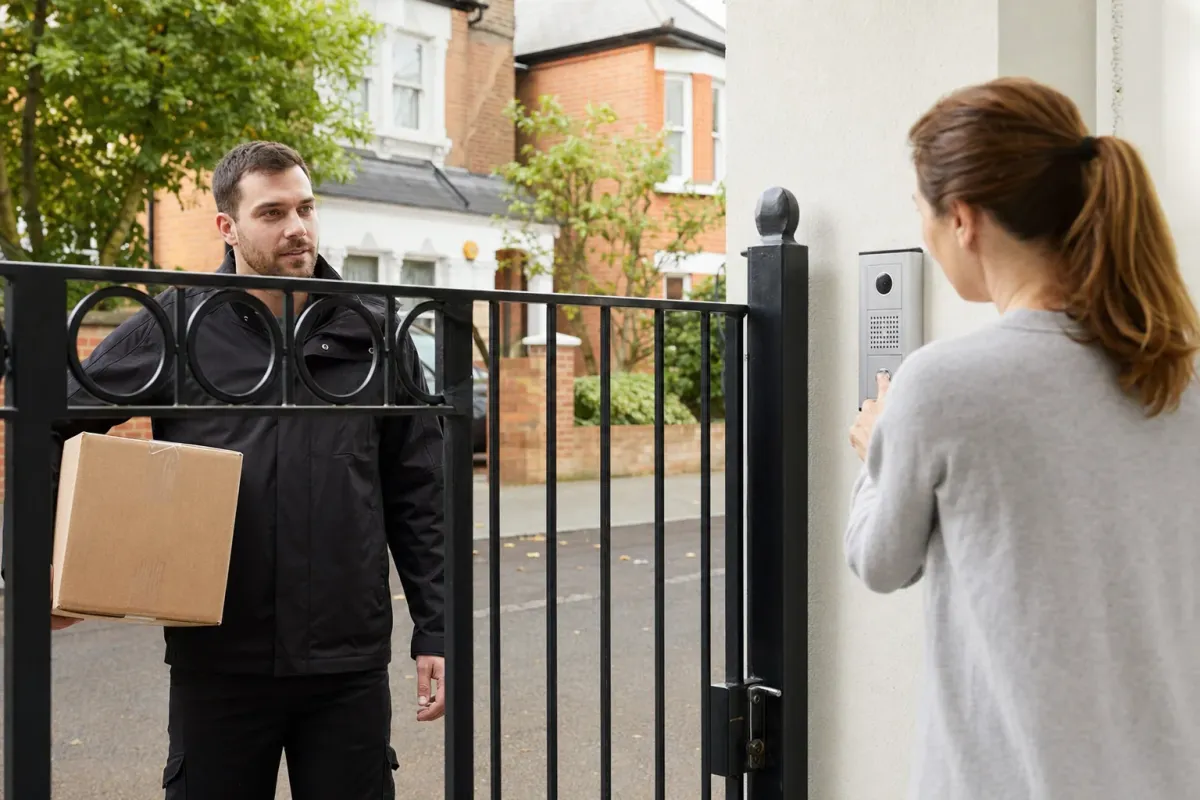
Choose a delivery routine that works when you are home, away or unable to answer an intercom.
Need a better delivery routine at your gates?
Tell us where parcels should go and how you want to answer couriers. Ask about intercom or access-control changes that suit your existing gates and household routine.
In this article7 sections
Choose where parcels should go
Decide whether a courier should enter the driveway or leave a parcel at an accessible delivery point outside the powered gate. Give clear instructions that do not require climbing, reaching through the gate or leaving goods in its movement path.
Consider pedestrian access and the position of a parcel box before adding an entry device. A delivery routine should also work when you cannot answer a call.
Fit the delivery routine into your wider driveway and home security plan, including side access, vehicle protection and arrangements when nobody can answer.
Manage codes and visitor calls
A keypad can offer temporary or separately managed codes if the selected product supports them. Check how codes expire and how you remove access. Avoid placing a permanent household code in public delivery notes.
A video or phone intercom lets you speak with the visitor, subject to the installed connection and app features. Notifications, recordings and remote release vary by model and account. Request a demonstration rather than assuming they are included.
Keep movement and access separate
Letting a visitor in does not confirm that the gate’s path is clear. The installation needs protective measures for the actual entrance, and users need instructions on where to wait and move. Do not ask a courier to hold a powered leaf open or obstruct a sensor.
Agree an alternative for network or power failure. Keep manual release to trained users following the supplied instructions, rather than sharing a generic release sequence with delivery drivers.
Choose the equipment around the routine
Compare keypad access, video entry and phone entry. Check account ownership and recurring charges in the quotation. Our gate safety guide explains the handover information to request.
Compare delivery routines before buying equipment
| Routine | What to confirm | Limitation to plan for |
|---|---|---|
| Parcel point outside the vehicle gate | A visible, accessible location that leaves the footway and gate movement clear. | Parcel size, collection and the courier’s ability to use it. |
| Resident answers an intercom | Where the call arrives and how entry and exit are managed. | Nobody answers, or the connection fails. |
| Temporary code where supported | Who creates it, when it expires and which entrance it operates. | An expired or forwarded code and a driver needing assistance. |
| Agreed staffed delivery window | Who receives the delivery and supervises the agreed access routine. | A vehicle arriving early, late or at the wrong entrance. |
Choose the fallback at the same time as the preferred routine. A new control adds little convenience if every missed call still leaves a driver unable to reach an agreed delivery point.
Write instructions a first-time courier can follow
Describe the correct entrance, where to wait and how to call the recipient. Include a recognisable house number or entrance name rather than relying on a driver seeing an app map at exactly the right scale. Keep instructions short enough to follow without entering the gate path.
State what to do if nobody answers. That might be a specified parcel point or the carrier’s normal failed-delivery process. Do not invite a driver to climb over, reach through, defeat a latch or follow another vehicle inside. Check the carrier’s own delivery options rather than assuming it accepts every arrangement.
For bulky items, agree access with the supplier before the delivery day. Confirm the vehicle and handling space, and explain any restrictions. A routine suitable for a small parcel may be unsuitable for a pallet or a long vehicle.
Test the routine with the household
Walk through the plan with the installer and the people who receive calls. Include someone using a normal resident account instead of only the administrator’s phone. Ask how temporary permissions are removed and how to contact support if a delivery code does not work.
Review the routine after a phone change, new tenant or change in work hours. Keep the parcel point and signs usable as planting grows or bins move. The aim is a repeatable delivery process that does not depend on improvising around a powered gate.