
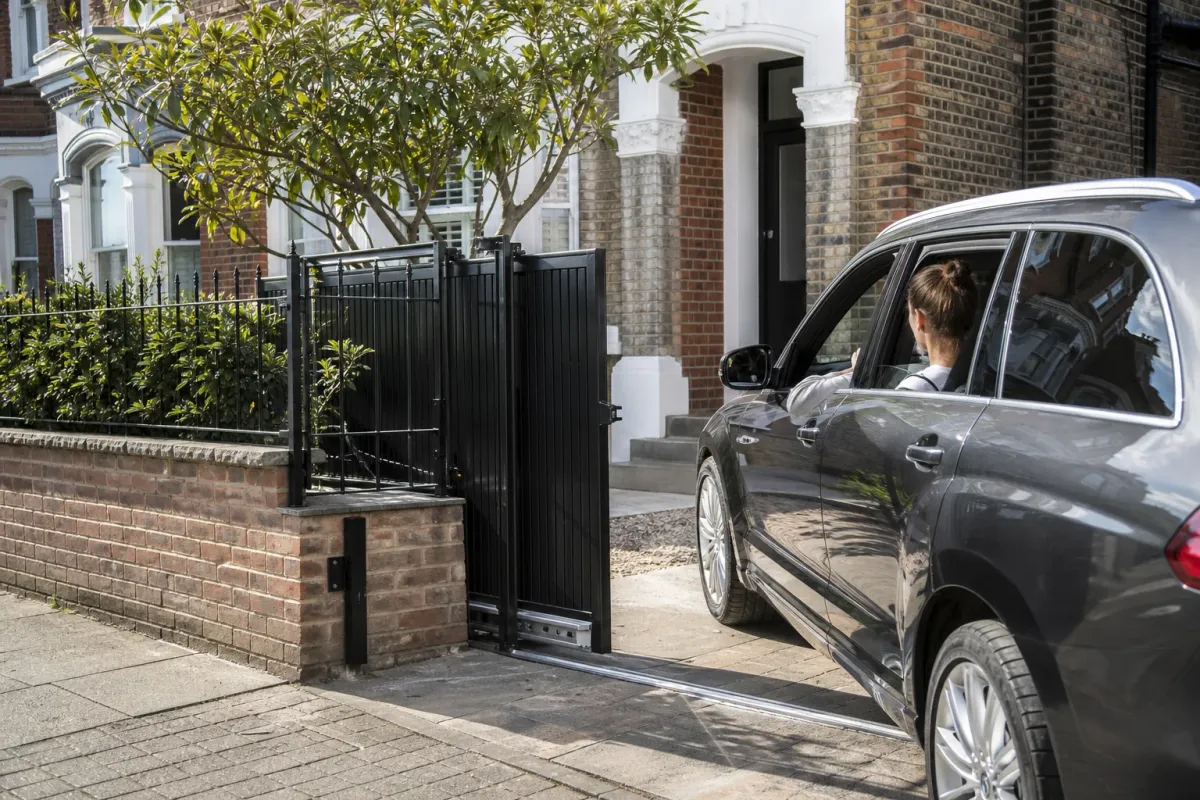
How a telescopic gate works
A standard sliding gate is one panel. It needs side space at least as wide as the opening, because the whole panel has to slide clear. A telescopic gate splits that panel into two (or sometimes three) narrower panels on parallel tracks.
The motor drives the front panel, which travels the full width of the opening. A cable, belt or pulley system links it to the rear panel, which moves at half the speed and travels half the distance. Both panels start and finish together, arriving neatly side by side behind the end post when open and overlapping slightly in the middle when closed. Everything runs from one motor and one set of controls, just like a single sliding gate.
How much space you need
Side space. A two-panel gate needs roughly half the opening, plus an overlap of a few hundred millimetres. A 4-metre opening, which would need about 4.3 metres of side space with a standard tracked gate, needs only around 2.3 metres with a two-panel telescopic gate. A three-panel gate needs about a third of the opening plus overlaps, so around 1.6 metres for the same 4-metre opening. The survey gives exact figures for your entrance.
Depth. Because the panels sit side by side when open, a telescopic gate needs more depth behind the boundary than a single gate. Allow roughly 300 to 450 mm for a two-panel gate, depending on the gate thickness and running gear. Most front drives have that easily, but it’s worth checking where a path or flower bed runs along the inside of the boundary.
A level, clear run. As with any sliding gate, the ground along the gate line and the parking area for the open panels needs to be straight and roughly level, and clear of downpipes, meters, steps and tree roots.
When telescopic is the right choice
Telescopic gates make sense when a sliding gate is the right idea but a single panel won’t fit. Typical London examples include:
- the house wall, garage or a side passage gate meeting the boundary just beyond the entrance
- a corner plot where the boundary turns
- a mature tree or protected hedge beside the opening
- a wide double-width drive where there’s room for half the gate on one side but not the whole of it
They also work well where swing gates would clash with parked cars or a drive that rises behind the gate. Those are the same reasons people choose sliding gates in the first place. See electric sliding gates for the wider picture.
Tracked or cantilever
Most residential telescopic gates are tracked, with each panel running on its own steel rail across the entrance. That makes them reliable and economical, but both tracks need to be kept clear of leaves and grit, and they’re not well suited to gravel drives.
Cantilever telescopic gates have no tracks across the opening. They’re less common, more complex and more expensive, and they still need a counterbalancing tail, so they save less space. We generally recommend them only where a clean threshold is essential and the side space allows.
The trade-offs
A telescopic gate has more moving parts than a single panel: two sets of wheels, two tracks and the linking mechanism. That means a higher price, a little more maintenance, and a mechanism that needs correct tensioning to keep the panels in step. Two panels side by side are also slightly more visible from inside the property than a single gate.
There’s also an extra safety point. Where the panels pass each other, there’s a shearing point that has to be guarded. We fit safety edges and cover any gaps so fingers can’t be caught between the panels, alongside the usual photocells and safety edges on the leading edge. Closing forces are tested and recorded against BS EN 12453 at handover.
Materials
Aluminium is the best material for telescopic gates. Keeping the panels light reduces the load on the motor, wheels and linking mechanism, and aluminium won’t rust. It suits slatted, solid and wood-effect designs. See aluminium driveway gates. Galvanised steel works for heavier-duty and commercial gates. Timber and composite infill can be used on an aluminium or steel frame, but heavy solid panels are generally better avoided on telescopic gates. Remember that solid panels catch the wind, and a telescopic gate has two of them.
Motors and controls
Telescopic gates use the same motors as standard sliding gates. 24V motors are the usual choice for homes, because they slow the gate gently at each end, detect obstructions precisely and can run on battery backup in a power cut. A part-open setting lets the gate open about a metre for people on foot. Every type of access control works with them: video intercoms, keypads, GSM phone entry and ANPR.
Installation
Each track sits on a concrete foundation across the opening, alongside a plinth for the motor and an end post where the panels close. Ducting for power and controls goes in at the same time, and the paving or tarmac is made good around the work. Most residential telescopic gates are installed in two to four days, depending on the groundworks.
Cost of telescopic sliding gates in London
As a rough guide, a two-panel aluminium telescopic sliding gate for a typical 3.5 to 4.5-metre residential opening costs £8,000 to £14,000 supplied and fitted with motor and basic controls. Three-panel gates, steel construction, cantilever designs and wider commercial openings cost more. Intercoms and extensive groundworks are itemised separately. See our installed gate cost guide.
Looking after a telescopic gate
Have the gate serviced once a year. A service covers the motor, safety devices and closing force test, plus the tension of the linking mechanism and the condition of the wheels and rollers on both panels. In between, keep both tracks clear and the photocell lenses clean. If the panels start arriving out of step, the linking mechanism probably needs adjusting. See gate repair and servicing.