
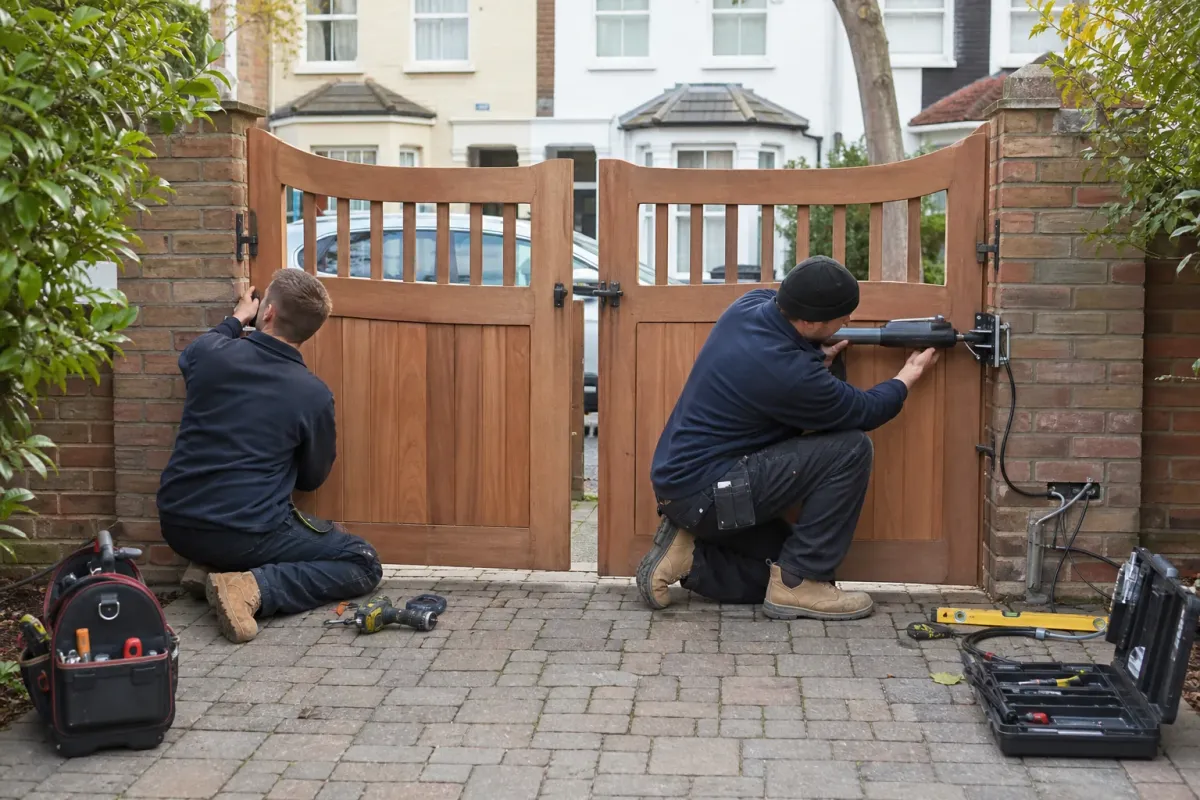
Build a retrofit budget that includes the gate assessment, supports, power, controls and completed-system checks.
Budgeting to automate the gates you already have?
Tell us about the existing gates, supports and nearby power supply. Ask for a retrofit quote that includes the condition assessment, controls and work around the motors.
In this guide11 sections
Check whether the existing gate can be automated
Start with the gate and supports, before choosing a motor kit. The survey should assess condition, hinges or running gear, movement, dimensions, exposure to wind and hazards around the opening. A manual gate that can be pushed by hand is not automatically ready for powered operation.
Ask whether the proposal needs repairs, altered supports, a different opening arrangement or replacement leaves. Include that work in the comparison with a new gate.
Separate the quotation into work packages
Request separate descriptions for gate repairs, motor and controls, power supply, cable routes, groundworks and surface reinstatement. Include access equipment, protective measures and any work by other trades.
Record VAT, removal and disposal, appointments, permissions and exclusions. A kit price covers a different scope from an installed and checked entrance. The cheapest motor listing cannot establish the completed project cost.
Specify operation and handover
Explain how often the gate operates, who uses it and whether you need pedestrian access, delivery entry or an intercom. Ask for the proposed product models and the basis for choosing them.
The quotation should identify completed-system checks, documentation, user instruction and manual-release training. Confirm maintenance, repair support and the separate equipment and installation warranty terms in writing.
Compare retrofit and replacement
If repair and alteration costs are substantial, request a replacement option with equivalent appearance and controls. Compare the complete scope, disruption and upkeep rather than assuming retrofit must be cheaper.
Use the installed gate cost guide alongside our gate automation service. Send photographs, approximate dimensions and known faults when you discuss your entrance.
Further reading: HSE guidance on complete-system assessment.
Compare surface-mounted and underground operators
The operator type affects both the appearance of the gate and the installation work. Compare an above-ground linear or articulated-arm proposal with an underground proposal using the actual hinge and support arrangement. Ask for a drawing showing mounting positions, movement and access for servicing. Product names alone do not establish that either arrangement will fit.
| Option | Work to establish | Questions for the quotation |
|---|---|---|
| Above-ground linear arm | Mounting geometry on the leaf and support, brackets, cable route and movement clearance. | Can suitable fixings be made to the existing structure, and what alterations are included? |
| Above-ground articulated arm | Space for the linked arm and suitable mounting on the support and gate. | Where does the mechanism move, and how will the surrounding area be assessed? |
| Underground operator | Foundation box, hinge relationship, excavation, drainage, cables and access to covers. | Who provides drainage and reinstates the driveway, and what remains visible? |
| Existing sliding gate drive | Condition of the gate, running gear, supports and compatible drive arrangement. | Which existing parts can remain and what needs repair before automation? |
Above-ground equipment can still require groundworks for supports or cables. Underground equipment can still leave covers and release fittings visible. Compare the documented site work rather than treating one option as excavation-free or the other as completely invisible.
Identify what a motor kit actually includes
Ask for a component list tied to the supplier and model numbers. Depending on the offer, a kit may include operators, a controller, receivers or selected accessories. It may exclude the equipment and work needed to make your particular entrance suitable. Have the installer mark supplied, retained and separately priced items on the same list.
A pair of existing manual gates also needs consideration as a structure and as a moving entrance. Photograph the hinges, supports and gate from safe positions, and send the approximate leaf dimensions. Tell the contractor about sagging, rubbing, repairs or occasions when wind moved a leaf unexpectedly.
Do not use a catalogue maximum weight as the only selection rule. Ask the contractor how the proposed equipment suits the gate dimensions, mounting geometry, infill, exposure and operating demand. The answer should identify the equipment being priced, not just promise a powerful motor.
Power routes and driveway work can change the budget
Draw the approximate route from the entrance towards the available supply and flag finished paving, steps, walls, trees and inspection covers along it. The electrician and gate installer need to establish the actual electrical requirements and cable route. A photograph can help an initial discussion but cannot confirm the condition or suitability of the supply.
If you plan a new driveway, agree ducts, foundations and finished levels before the paving programme starts. Name who provides each part of the work and who checks the interfaces between trades. Include making good even where an existing route may be reusable; the quote should say what happens if inspection finds that it cannot be used.
For underground operators, request a specific drainage proposal for the site. Ask how covers remain accessible after resurfacing and how future equipment replacement would be approached. These are ownership questions as well as installation costs, because the cheapest initial arrangement may be inconvenient to maintain.
Use a quotation worksheet instead of a generic price band
Create one row for each work package and one column for each proposal. Copy the contractor’s description and price into the worksheet without converting an allowance into a fixed amount. Leave an item marked not stated until the contractor clarifies it. That makes omissions visible before a deposit is agreed.
Separate the base installation from choices such as a different intercom, extra remotes or an additional pedestrian entrance. Record ongoing charges beside the features they support. A smartphone option may involve different ownership and connectivity arrangements from a fixed indoor answering point.
Check payment stages, quotation validity, VAT treatment and how variations require approval. Ask what happens if concealed damage or unsuitable foundations emerge after work starts. Avoid assuming an advertised equipment price includes fitting, electrical work, disposal or complete-system checks.
Where two proposals differ materially, ask for a comparable alternative rather than negotiating an unexplained total. A contractor who includes replacing damaged supports is pricing a different job from one who assumes that the existing supports can remain.
Three retrofit scopes to discuss with the installer
For sound gates with suitable supports, the main question may be the operator arrangement and the work needed to connect, protect and commission the entrance. Ask the installer to confirm the condition and list retained components. Treat this as a possible scope, not an assurance that your own manual gates are ready.
For gates that sag or scrape, separate the repair proposal from automation. Ask what the repair would achieve, how the result would be assessed and whether further alterations remain necessary. A motor should not become the explanation for forcing a poorly moving gate through its travel.
For an entrance that needs major support work and new controls, compare a complete replacement using an equivalent design brief. Retaining the leaves may still be worthwhile for appearance or conservation reasons, but the quotation should show the cost and limitations of that choice.
These examples explain why a useful budget begins with a scope. Once the contractor has surveyed your gate, request a written proposal you can compare against the alternative, with the same finish, controls, safe operation and handover requirements.
Agree the changeover day
Ask how long the entrance is expected to be unavailable and where vehicles should be parked during the work. Confirm access for residents, pedestrians and deliveries, especially if the gate is the only entrance. Programme electrical and driveway work around the installation rather than leaving responsibility unclear between contractors.
Before paying the final balance under your agreed terms, request the documented checks, user instructions and demonstration included in the quotation. Identify who will deal with any incomplete item and when it is expected to be resolved. Keep model numbers, settings records supplied for the owner and warranty documents together.
If the installer discovers work outside the agreed scope, request the reason, revised price and effect on the programme before authorising it. That is more useful than trying to compare an unexpectedly enlarged retrofit with an earlier equipment-only estimate.