
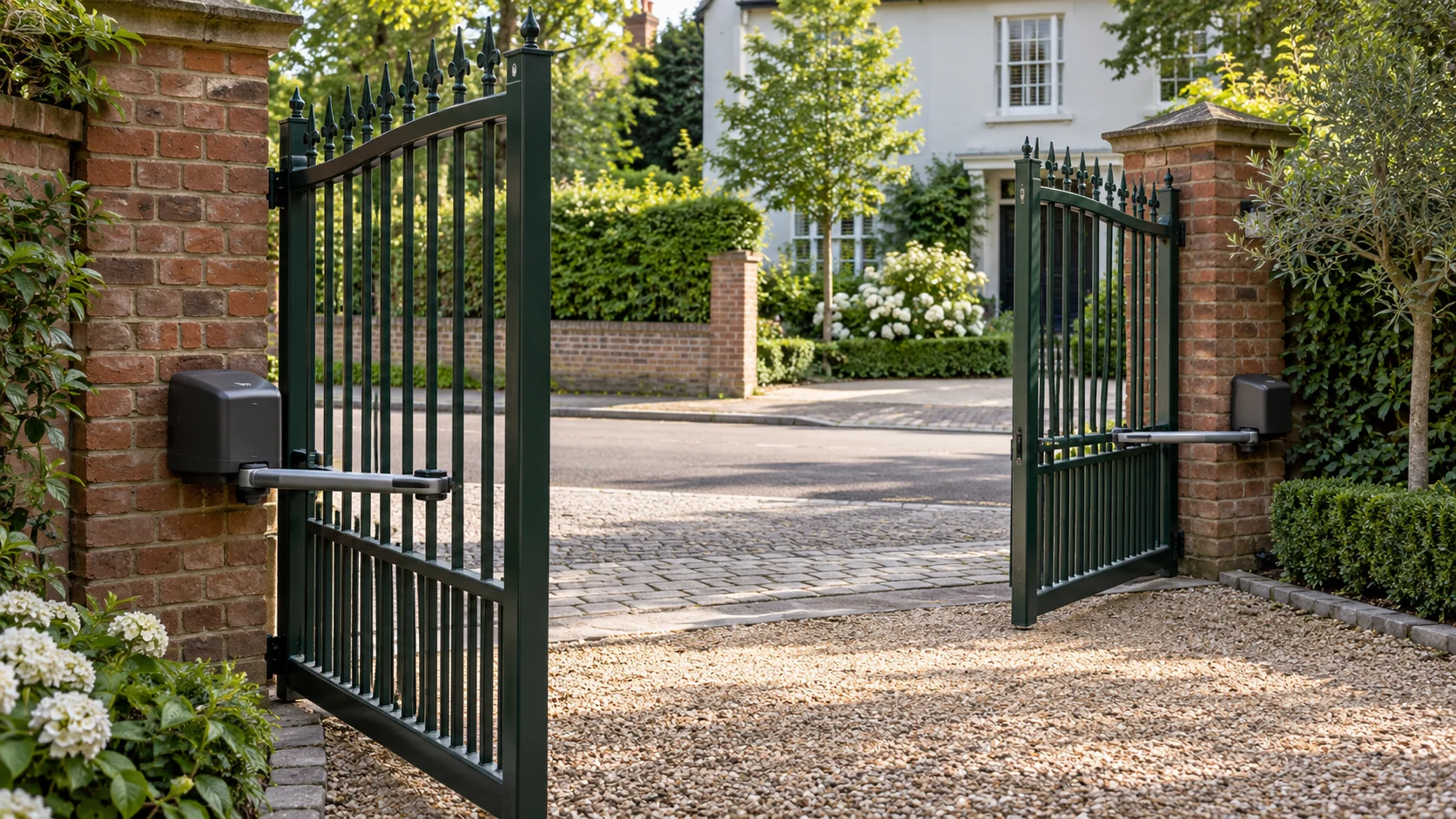
Yes, you may be able to replace the automation while keeping your existing driveway gates. A competent installer needs to assess the gate leaves, supports and movement, then specify equipment that works with the parts you retain. Keeping the gates does not mean keeping every motor, cable or control, and an attractive entrance can still need mechanical repairs before new automation goes in.
This option suits a different question from whether to approve another fault repair. You have decided to investigate new drive equipment and now need to understand the work around it. For an earlier comparison of the options, read about repairing or replacing gates that keep breaking down. Here, the focus is what an automation replacement should include when you want the visible gates to stay.
Separate the gates from the equipment you want to change
Start by describing what you want to preserve: the appearance of the entrance, the gate leaves, the brick piers, or all of those. Then describe what you want the replacement to do. You might want to replace unsupported equipment, address a diagnosed recurring problem or change how residents operate the entrance. Give the contractor the reason for the project before discussing a particular motor.
Ask for a retained-and-replaced list. It should name the gates and supports, motors, brackets, control panel, protective devices, power supply, cables, remotes and entry controls. Mark anything the installer has not yet inspected as provisional. That list gives you a useful way to compare quotations and avoids discovering halfway through the work that you and the contractor understood “new automation” differently.
Check the structure and movement before choosing motors
The installer needs to assess how the gates move and what carries their weight. For swing gates, discuss the leaves, hinges, mounting points and supports. For sliding gates, the assessment should cover the support and guidance arrangement along the travel path. Describe scraping, sagging or changes in alignment, even if the old automation could still move the gate.
HSE treats powered-gate safety as a question about the assembled installation and its surroundings. Stronger drive equipment is not a substitute for resolving a defective structure or unsuitable movement. Ask the engineer to separate mechanical repairs from the automation specification so you can see what makes retaining the gates viable. Have them explain any recommendation to change the supports or the gate design.
Leave manual movement checks and release procedures to someone who understands the installation. A gate that looks manageable can move unexpectedly once its drive no longer restrains it. You can help by collecting records and describing symptoms without opening control enclosures or disconnecting equipment.
Specify a replacement for this entrance
An installer should select the drive arrangement for the actual gate and its use. The existing motor's brand or outward appearance cannot establish that another model will fit. Provide any readable model details from accessible labels, together with earlier installation drawings. The contractor should verify the relevant equipment information rather than build a quotation around a photograph alone.
Discuss where new equipment would sit. On a swing gate, ask whether the proposed brackets and operator position require changes to the leaf or pier. If you have underground operators, ask whether the proposal retains their housings and how the installer will assess those areas. For a sliding gate, ask what the replacement involves at the drive and its connection to the gate. Request a sketch if the explanation is hard to picture.
When comparing automation for existing driveway gates, have the contractor identify the proposed equipment and the parts it relies on. Do not treat a boxed kit's component list as the complete specification for your entrance. Include any additional work in the written proposal before you place the order.
Decide what happens to cables, remotes and the intercom
Keeping the gates does not establish whether the old electrical supply and cabling can stay. Ask the contractor to inspect the existing provision, explain what it can reuse and identify any areas it cannot assess without further access. Cable routes beneath a finished driveway deserve attention at the survey stage, particularly if avoiding disturbance is a priority for you.
Tell the installer how you operate the entrance now. List remotes, keypads, intercoms, phone access and any arrangements for visitors. Discuss gate access controls alongside the replacement controller. A working intercom still needs a compatibility check with the proposed system; the installer should confirm which functions will remain available.
For a shared entrance, appoint someone to coordinate the change. Keep a record of how many authorised users need access, who holds programming information and who can manage any connected account. Agree how the contractor will issue replacement controls or transfer access. Share credentials through an appropriate private channel, rather than putting them in a notice circulated to every resident.
Include a fresh review of protective measures
Changing the automation affects the equipment that controls gate movement. The installer needs to consider the complete arrangement, including the retained parts, protective devices and the way people use the entrance. Existing photocells alone do not demonstrate that a replacement system will be safe. Ask how the assessment addresses the gate's movement and the places where someone could become trapped.
HSE's guidance on modifying powered gates explains that significant modifications can require a new conformity assessment. Ask the installer to explain how that applies to the proposed scope and who will take responsibility for the completed installation. A component repair and a substantial alteration do not necessarily have the same implications.
Request the relevant assessment, checks and handover documents as part of the quotation. Ask the contractor to identify any restriction on using the existing gates before the work starts. If an engineer has advised taking the system out of use, agree safe temporary access instead of continuing to operate it while you compare prices.
Compare the whole installation price
A motor price leaves too much unanswered for this decision. Obtain an itemised installed quotation that describes both the new equipment and the work needed around it. You can then compare the contractor's proposal with another offer without assuming they include the same retained components or preparation.
- Preparation: assessment, removal of redundant equipment, repairs to retained gates or supports, and disposal.
- Installation: named drive equipment and controls, protective measures, electrical work, cable routes and any drainage work identified at the survey.
- Finishing: repairs to paving or finishes, programming, checks, user instructions and a demonstration.
- Terms: whether VAT applies and is included, payment stages, exclusions, warranty conditions and approval of extra work.
Keeping sound gates may avoid replacing those leaves, but it does not establish a fixed saving on the overall project. Additional structural or electrical work can change the comparison. Ask each contractor to identify uncertain items and explain when it will be able to price them. Agree an approval point for extra work before anyone removes equipment or opens up the driveway.
Plan access while the work takes place
Explain how you need to use the entrance during the project. Include pedestrian access, vehicle movements and deliveries that you cannot rearrange. Ask who will secure the site when work stops for the day and what you should do if the gates cannot return to use as expected. Agree a programme based on the surveyed work and confirmed equipment availability.
A different contractor may be able to undertake the replacement. If your original installer is unavailable, read about working on gates installed by another company, and supply the new engineer with the records you have. Confirm acceptance of the existing installation before assuming another firm can support every retained component.
Check the handover against the quotation
Before the contractor finishes, work through the retained-and-replaced list together. Ask them to record any changes agreed during installation and show you how to operate the finished system. Arrange for the person who manages a shared entrance to attend, so that operating instructions reach the people who need them.
- Check that the work record identifies the fitted equipment and the existing parts that remain.
- Request the relevant instructions and assessment or testing records for the completed work.
- Ask for a demonstration of normal operation and the approved arrangements for a power failure or fault.
- Confirm maintenance recommendations, support contacts and the written warranty terms, including treatment of retained equipment.
Keep these documents with the previous service history. HSE advises that powered gates need maintenance to remain safe; your installer should explain the arrangements for this particular installation. You should leave the handover knowing what changed, what stayed, how to use the entrance and who to contact if it behaves differently. That is the practical test of a replacement proposal that keeps the gates you want to retain.