
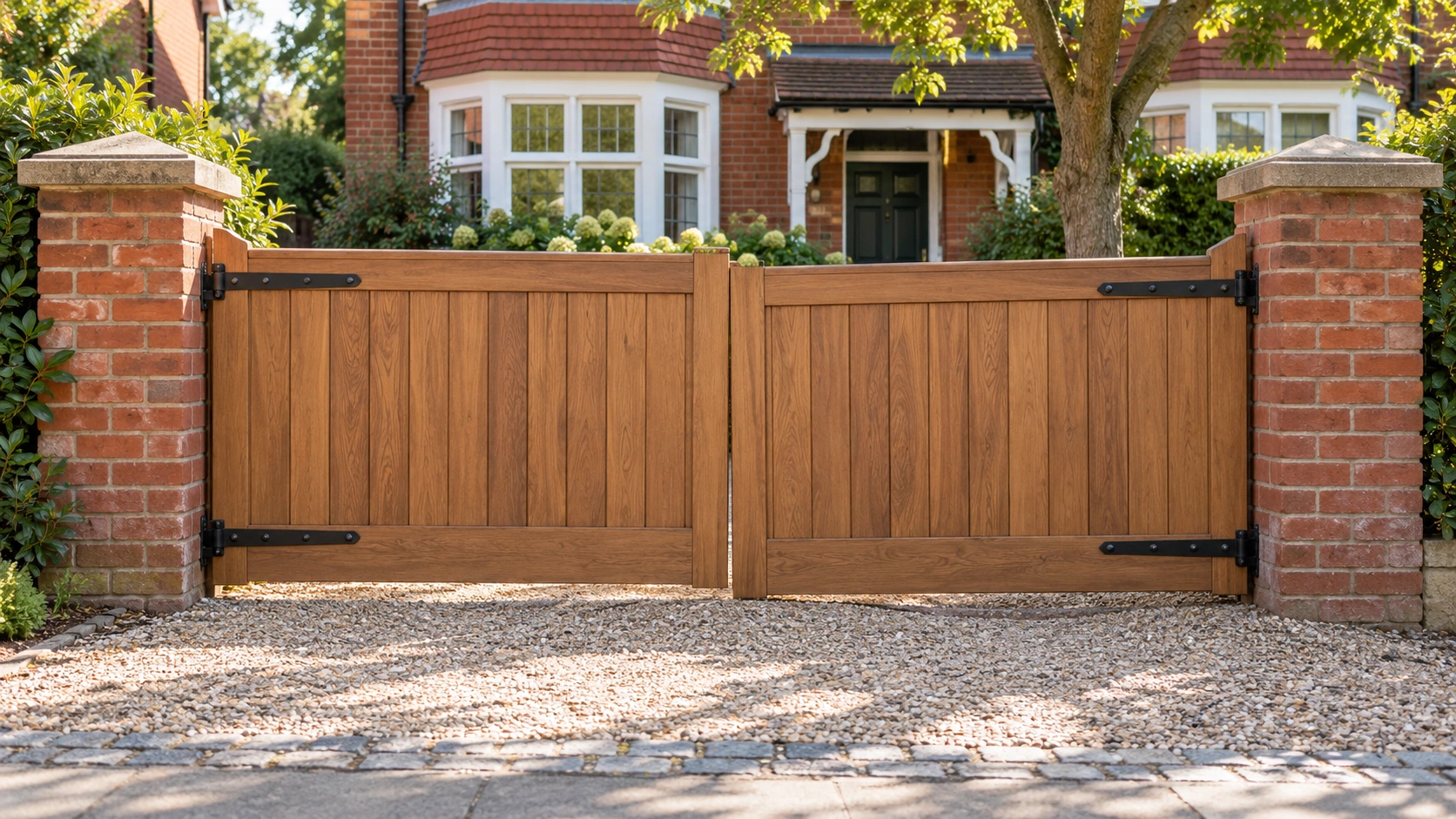
A sagging driveway gate has dropped at its free end, so it scrapes the ground, no longer meets its partner at the centre or needs lifting to latch. The fix depends on which part has moved. Worn hinges, a leaf that has lost its shape and a post or pillar that has started to lean all produce the same symptom, and only one of them is solved by adjusting a hinge.
The short takeaway: work out what has moved before paying for any repair, and do not lift, rehang or adjust a heavy or automated gate yourself. On electric gates, a sagging leaf changes the gaps and forces the safety design relies on, so stop using the automation if the leaf is dragging or the gaps look different.
Driveway gates sagging or dragging?
Tell us which leaf has dropped, where it scrapes and whether the posts look upright. Ask about assessing the hinges, leaves and supports and the repair work your gates may need.
In this article9 sections
Three Things That Can Move
Every swing gate hangs its weight from the top hinge and pushes against the bottom one, and that leverage grows with the width of the leaf. Over time, three things can give way.
- The hinges: pins, bushes and bearings wear, and fixings work loose in timber, metal or masonry, so the leaf drops a little each year.
- The leaf: a timber gate can rack out of square if its brace was fitted the wrong way or its joints have failed, and a metal frame can bend after an impact or corrosion.
- The support: a timber or steel post can lean or rot at ground level, and a brick pillar can crack, tilt or move on its foundation.
On a timber gate, the diagonal brace should run upwards from the bottom of the hinge side to the top of the closing side, so that it is pushed rather than pulled by the leaf’s weight. A brace fitted the other way round is one reason a fairly new wooden gate can sag, and adjusting the hinges will not correct it.
Simple Observations Before You Call
You can narrow down the cause from a safe position, with the gate stationary and any automation switched off at its normal control. Do not put fingers near hinges or the gap between the leaf and the post.
- Look along the top rail. If it slopes down from the hinge side but the post is upright, suspect the hinges or the leaf.
- Check the post or pillar against a vertical line such as a door frame or downpipe. A lean or a crack at its base points to the support.
- Look for daylight around the hinge fixings, fresh rust trails, split timber or cracked mortar beside the brackets.
- Note whether the gap at the bottom of the leaf changes as it swings, and where it scrapes.
- On a pair of gates, note whether one leaf has dropped or both, and whether they still meet at the centre stop.
- Photograph the hinges, the base of each post and the centre meeting point.
Tightening a loose screw on a light timber side gate is a different task from adjusting the hinges of a heavy driveway leaf. Driveway gates can weigh far more than they look, and a leaf that comes off its top hinge during adjustment can fall. Leave lifting, removal and hinge adjustment on driveway gates to a gate engineer.
Why Sagging Matters on Electric Gates
Automation is designed around a gate that moves freely and stays in shape. The FAAC 412 installation instructions, for one swing gate operator, require a strong and rigid leaf frame, smooth movement with no stiff points, hinges in good condition and mechanical travel limit stops, and ask users to have the gate structure checked periodically, particularly the hinges. A dropped leaf breaks several of those conditions at once.
The HSE’s powered gate safety guidance lists closing gaps at hinges that create crushing points, and gaps between a moving leaf and fixed parts, among the hazards a gate’s design must deal with. When a leaf sags, those gaps change. The motor also has to push a leaf that drags, which can make the gate stop or reverse, and an installer who simply turns up the force to overcome the drag moves the safety settings in the wrong direction.
If the gate has started to stop part way or reverse, or only one leaf opens, mention the sag when you report the fault. Ask the engineer to check the leaf and hinges before any motor or control board is replaced.
Dry Summers and Moving Posts in London
Posts and pillars do not only move because of age. The British Geological Survey says shrink-swell clay soils are most common in the London area and the south-east, describes London Clay as very susceptible to volume change, and notes that tree roots can dry the ground and make it shrink. Damage occurs when that movement is uneven beneath a foundation, which is exactly the situation of a single gate post or pillar carrying a heavy leaf.
The Met Office reported in January 2026 that 2025 was the UK’s warmest and sunniest year on record, with the warmest spring and summer in its series and widespread drought during those seasons. A gate that started to drop after a long dry spell, or that sags in summer and partly recovers in winter, may be telling you about the ground rather than the hinges. Tell the engineer about nearby trees, recent tree work and when the problem first appeared.
Repair the Hinges
Where the posts are upright and the leaf is square, hinge work is usually the first option. Depending on the hinge type, that can mean adjusting adjustable hinges, renewing worn pins, bushes or bearings, refixing loose brackets with fixings suited to the post or masonry, or replacing hinges that were undersized for the gate. On an automated gate, the engineer should check the alignment between the hinge and the operator afterwards, since moving the leaf changes the geometry the motor was set up for.
Support wheels and anti-sag kits appear in many search results. A wheel can carry some weight on a level drive, and a tension kit can pull a timber leaf back into shape, but neither cures a worn hinge or a leaning post. On electric gates, ask the installer whether either device suits the operator and the drive before anything is added.
Replace the Posts or Rebuild the Pillars
A leaning timber post, a steel post that has moved in its concrete or a pillar that has cracked through needs work on the support itself. Timber posts that have rotted at ground level are normally replaced rather than propped. Steel posts may need resetting on a new foundation. A brick pillar that carries a gate may need partial or full rebuilding, and the gate should only be rehung once the new work can carry its load.
If you are thinking about automating a manual gate, or replacing heavier gates with new ones, the condition of existing brick pillars matters before anything is hung from them. A pillar that has already moved under a manual timber gate is unlikely to cope with a heavier leaf and a motor without attention. Where the movement followed a vehicle strike rather than ground movement, the repair also needs to deal with damage from an impact to the hinges and motor.
Start Again With New Gates
New gates become the sensible choice when a timber leaf has rotted or lost its joints, when a metal leaf is badly distorted or corroded, or when the gates were never built for their width. Replacement is also an opportunity to choose a design suited to the supports you have. Lighter construction puts less load on hinges and pillars, and the trade-offs between aluminium and wooden driveway gates include stiffness, upkeep and repair options.
Older metal gates can often be repaired rather than replaced. Distorted frames can sometimes be straightened and hinges renewed during restoration of metal driveway gates, which keeps an original design that may be hard to match. If the gates have needed several repairs already, the question of whether further repairs make sense depends on the condition of the whole entrance.
Details to Send When You Book
- Your postcode, whether the gates are timber, metal or composite, and whether they are automated.
- Which leaf has dropped, where it scrapes and roughly when you first noticed.
- Whether the posts or pillars look upright and whether there are cracks at their base.
- Your photographs of the hinges, the post bases and the centre meeting point.
- Any nearby trees, recent tree work, impact or paving work.
- Any change in how the automation behaves, such as stopping, reversing or one leaf lagging.
Questions for the Repair Quote
Ask the engineer which part has moved and how they established it: hinges, leaf or support. Ask whether the quote includes post or pillar work, or whether a builder is needed, and what checks of the automation and safety gaps will follow. There is no dependable fixed price before inspection, because renewing a hinge pin and rebuilding a pillar are very different jobs.
When requesting electric gate repair and maintenance, say that the gate is sagging, which leaf has dropped and whether the posts look upright. That lets the engineer bring the right parts and start from what you have already seen.