
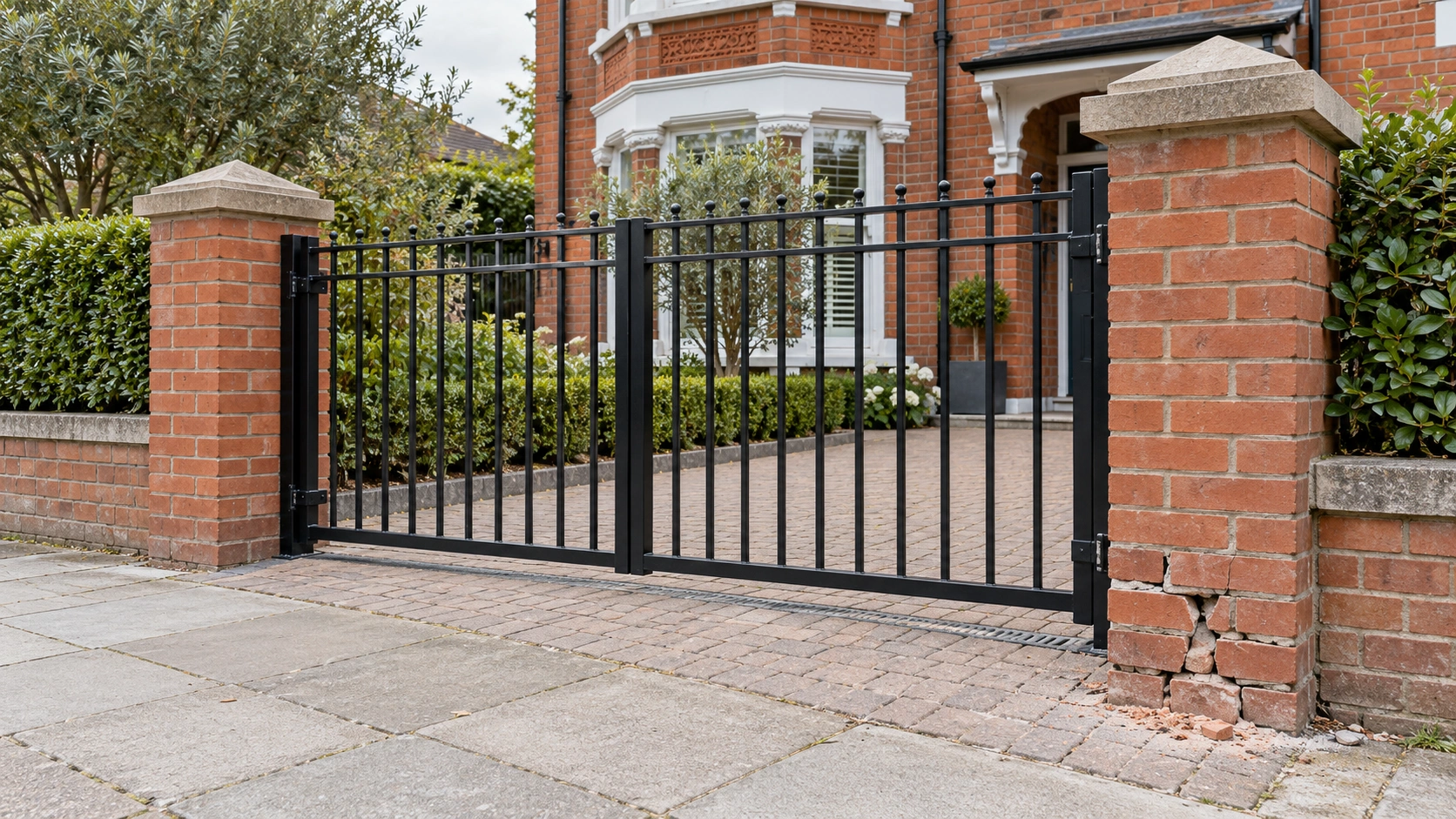
When a car hits a driveway gate, the visible dent is often the smallest part of the damage. The force travels through the leaf into its hinges, the pillar that carries them and, on an automated gate, the motor arm, gearbox and cables. A gate that still closes after a knock may be hanging from a loosened fixing or a cracked pillar, so the first job is to establish whether the entrance is safe, not whether it still works.
The short takeaway: keep people and vehicles away from the damaged leaf and pillar, stop using the automation and record everything before anything is moved. Do not try to force a bent leaf back into line, straighten a motor arm or prop up a leaning pillar. If cables or a control box have been damaged, keep clear and switch off at the consumer unit only if you can do so safely.
Gate or pillar hit by a car?
Tell us which leaf, motor or pillar was struck and how the entrance has been left. Ask about assessing the damage and the repair work your gates may need.
In this article10 sections
Immediate Safety After the Impact
The HSE’s powered gate guidance warns that gates can fall or be blown over and can rotate uncontrollably around their hinges, and says that gates found to be dangerous should be taken out of use until the safety concerns have been addressed. An impact can create exactly those conditions. Treat any of the following as a reason to keep the area clear until an engineer or builder has made it safe.
- A leaf hanging at a new angle, sitting on the ground or moving more freely than before.
- A hinge, hinge bolt or gate bracket that has pulled away from the pillar.
- Cracks, loose bricks, a lean or a displaced cap on a pillar or the wall beside it.
- A bent motor arm, a cracked motor housing or a control box knocked off its mounting.
- Exposed or pulled cables, a damaged photocell post or a broken keypad pedestal.
- On a sliding gate, a leaf lifted from its track or a bent guide post.
If the pillar or gate is close to the pavement, keep pedestrians away from the side where it could fall. Do not lean on a damaged pillar or hang anything from the gate to test it. A crack that looks minor on the outside can run through the bed joints where the hinge fixings sit.
Driver Details and Reporting
A driver who damages property has legal duties. Rule 286 of the Highway Code says a driver involved in a collision that damages property must stop, and give their name and address, the vehicle owner’s name and address and the registration number to anyone with reasonable grounds for asking. If they do not give their details at the time, they must report the collision to the police as soon as reasonably practicable and in any case within 24 hours.
If the driver is still there, take those details calmly and note the time, the vehicle and any witnesses. If the driver left without giving details, report the collision to the police and keep the reference number, since your insurer is likely to ask for it. Doorbell or CCTV footage that captured the impact is worth saving straight away, before it is overwritten.
Recording the Damage for Insurance
Before anything is cleared or temporarily repaired, photograph the whole entrance from the drive and the pavement, then each damaged part from a safe distance. Include the road surface, any debris and tyre marks. Note the date, time and weather. These records help whether the claim goes to the driver’s motor insurer or to your own home insurer.
Speak to the insurer before authorising permanent repairs, because it may want its own inspection or a written report from a contractor first. Ask how your policy treats accidental impact to gates, motors and controls, and whether making the entrance safe in the meantime is covered. Keep invoices for any emergency work separate from the main repair.
Gates, Motors and Brick Pillars Need Separate Findings
A thorough assessment looks at three parts of the entrance, and the right person for each may differ. Ask for findings on each, because a quote that replaces the motor without checking the pillar, or rebuilds the pillar without checking the hinges, leaves part of the question open.
- The gate leaves: distortion of the frame, damage to hinges and hinge pins, and whether each leaf still hangs true. Gate alignment and support problems after an impact can take weeks to show.
- The automation: motor arms, gearboxes, brackets, control box, cables and safety devices such as photocells and safety edges. On a sliding gate this includes the track, rack and guide rollers, and on underground systems the foundation boxes.
- The pillars and foundations: cracks, movement, lean, the condition of the hinge fixings within the brickwork and whether the pillar’s base has shifted.
A gate engineer can assess the leaves and automation and point out pillar damage, but a pillar that has cracked or moved may need a builder or bricklayer, and sometimes a structural engineer, to decide between repair and rebuild. Agree who leads the job so the gate is rehung only on sound supports.
Brick Pillar Repair or Rebuild
Surface damage to a pillar, such as a chipped brick or a broken cap, can often be repaired locally. A pillar that has cracked through, moved on its base or loosened around the hinge fixings may need taking down to sound work and rebuilding. Ask the builder how the new pillar will carry the gate’s weight and leverage, how the hinge fixings will be set, and how long the new work needs before the gate is rehung and automated again.
The Planning Portal’s guidance on gates, fences and walls says you do not generally need planning permission to maintain, improve or alter an existing wall or gate, provided its height is not increased and the property is not a listed building or within the curtilage of one. Rebuilding to the same height and design is therefore usually straightforward, but local rules can apply in a conservation area, so check with the council before changing materials or height.
Matching the original brick and mortar is worth discussing early. A rebuilt pillar in a different brick may be acceptable to you but not to a neighbour on a shared boundary or to the council in a sensitive street.
Motors, Cables and Safety Devices After a Knock
Motor arms and gearboxes are designed to move the gate, not to absorb a vehicle strike. A bent arm, a cracked housing or a gearbox that now grinds may need replacing even if the motor still runs. Cables can be stretched or cut where they enter the motor or run beneath the drive, and photocell posts are easily knocked out of alignment. If the supply trips after the impact, leave it off and tell the engineer.
After any repair to the leaves, hinges or automation, the gate’s movement changes, so ask whether the safety devices were checked before the gate went back into normal use. Where new wiring or a new supply is needed, ask the electrician which edition of the wiring regulations they are working to. The IET says BS 7671:2018+A4:2026 is now the current edition, following the end of the Amendment 2 transition period on 15 October 2026.
Repair Versus Replacement After an Impact
Many impact repairs involve straightening or replacing a section of the leaf, renewing hinges and resetting or replacing the motor arm. Replacement of a leaf becomes more likely when the frame is badly distorted, when the design can no longer be matched, or when a heavily repaired leaf would be weaker than the original. The wider question of repair versus replacement depends on the condition of the rest of the system, not just on the damage from one collision.
If the gates are sound but the automation was old and is now damaged, it may make sense to keep the leaves and pillars and change only the drive. Ask whether replacing the automation while keeping the gates is an option for your entrance, and how the insurer would treat an upgrade compared with like-for-like repair.
Access and Security While the Gate Is Out of Use
A damaged gate may be stuck open, stuck closed or impossible to secure. If the leaf and pillar are sound and the area is safe, the manual release for your gate can restore access, following the instructions for your particular system. If they are not sound, leave the gate where it is and arrange temporary access or security with the engineer.
An entrance left open for several days changes how exposed the drive and house are. Simple measures for driveway and home security are worth reviewing until the gate is back in service, and tell neighbours on a shared driveway what has happened.
Details to Send When You Book
- Your postcode, the gate type and the motor make if you know it.
- When the impact happened and which leaf, pillar or component was struck.
- Your photographs from the drive and the pavement.
- Whether the gate is open, closed or unsecured, and whether the power has been switched off.
- Whether a claim is being made and whether the insurer wants a written report.
- Whether the gate is your only vehicle access.
Questions for the Repair Quote
Ask the engineer to list the damaged parts separately for the leaves, the automation and the pillars, and to say which trade will carry out each item. Ask what checks follow the repair, whether matching materials are included and how long the entrance will be out of use. There is no dependable fixed price before inspection, because a bent hinge and a rebuilt pillar with a new motor are very different jobs.
When requesting electric gate repair and maintenance, say that the gate or pillar has been hit by a vehicle, what you can see and whether an insurer is involved. That lets the right people attend and the assessment start from the evidence you have already gathered.